

- My Real Experience With Low Supply and Pumping Stress
- How Often Should I Pump at Work? (Quick Answer)
- Pumping Frequency by Baby's Age
- Why Pumping Every 2–3 Hours Protects Your Supply
- 3 Realistic Pumping Schedules for Working Moms
- How Long Should Each Pumping Session Be?
- Your Legal Pumping Break Rights (UK + US + Canada)
- How to Maintain Your Milk Supply at Work
- Signs You're Not Pumping Often Enough
- Best Pumps for Working Moms
- Mistakes That Kill Your Supply (Avoid These)
- FAQ: How Often Should I Pump at Work?
- Conclusion: You Are Doing Something Extraordinary
If you’re going back to work and asking yourself — how often should I pump at work so my milk supply doesn’t drop? — you are not alone.
Returning to work while breastfeeding is one of the most stressful phases of early motherhood. You’re managing meetings, deadlines, childcare logistics — and now you’re trying to protect your milk supply in a workplace that was never designed with nursing mothers in mind.
If you’re also navigating broken nights and emotional exhaustion during this transition, you may find comfort in my guide on Newborn Won’t Sleep Unless Held at Night – 9 Gentle Fixes That Work — because sleep struggles and pumping stress often go hand in hand.
Let’s make this simple, realistic, and clear.
But first — before the schedules and the tables — I want to share something personal. Because the most important thing I learned about pumping didn’t come from a chart. It came from panic, 20ml sessions, and a cousin who changed my mindset completely.
My Real Experience With Low Supply and Pumping Stress
Four days after delivery, something unexpected happened.
My baby suddenly stopped breastfeeding. She refused the breast completely and preferred the bottle. I was still physically recovering from birth, emotionally overwhelmed, and completely unprepared for this shift.
I had no choice but to start pumping.
I bought a manual pump first — it was affordable and easily available. But it was incredibly hard. Pumping was painful, exhausting, and discouraging. After long, tiring sessions, I would get barely 20ml.
Seeing such a small amount made me panic.
I started asking myself:
- Is my milk supply too low?
- Am I failing my baby?
- Will she stop getting breast milk entirely?
The stress made everything worse. And the more stressed I became, the less milk I produced. It felt like a spiral with no way out.
That’s when I started researching electric pumps. My cousin — also a new mom at the time — suggested I switch to a double electric pump. She told me something that completely changed my mindset:
“When I started pumping every three hours consistently, my supply increased.”
She had started with very low output too. But she stayed consistent. Every 3 hours. No skipping. No panicking.
Within a few days, her milk flow improved significantly. Eventually, she was storing milk in the refrigerator — and later even donated breast milk.
That’s when I understood something powerful:
Milk supply responds to stimulation. Consistency matters more than panic.
When I switched to a double electric pump and followed a regular 3-hour schedule, my body slowly adapted too.
If you’re wondering how often should I pump at work — especially if you’re worried about low supply — please remember this:
Low output at the beginning does NOT mean failure. It means your body is still learning.
Frequent, consistent pumping every 2–3 hours sends a strong signal to your body to keep producing. Your job isn’t to produce the most milk in one session. Your job is to show up, consistently, every few hours.
That’s it. That’s the whole secret.
“Consistency builds supply. Not perfection. Not panic. Just showing up every 2–3 hours.”
— A reminder for every working mom
If you’re also navigating sleepless nights during this transition, you might find comfort in my guide on
Newborn Won’t Sleep Unless Held at Night — 9 Gentle Fixes That Work — because pumping and sleep deprivation often go hand in hand.
How Often Should I Pump at Work? (Quick Answer)
Most working moms need to pump every 2–3 hours during their shift.
For a standard 8-hour workday, that usually means:
- 2–3 pumping sessions at work
- 1 nursing or pumping session before leaving home
- 1 nursing session when you return home
Your pumping schedule should mirror how often your baby feeds at home.
Pumping Frequency by Baby’s Age
| Baby's Age | Pumping Frequency | Sessions in 8-Hour Shift |
|---|---|---|
| 0–3 months | Every 2–3 hours | 3 sessions |
| 3–6 months | Every 3 hours | 2–3 sessions |
| 6+ months | Every 3–4 hours | 2 sessions (monitor supply) |
Younger babies require more frequent milk removal. As your baby grows and begins solids, you can gradually reduce sessions — but always monitor supply and wet nappies before cutting back.
Why Pumping Every 2–3 Hours Protects Your Supply
Breast milk works entirely on supply and demand.
When milk is not removed regularly:
- Your body receives a signal to produce less
- Engorgement increases — painful and potentially dangerous
- Risk of blocked ducts rises
- Long-term supply can decrease permanently
That’s why the answer to how often should I pump at work is not just about convenience — it’s about protecting the feeding relationship you’ve worked so hard to build.
One missed session won’t destroy your supply. But regularly skipping sessions will.
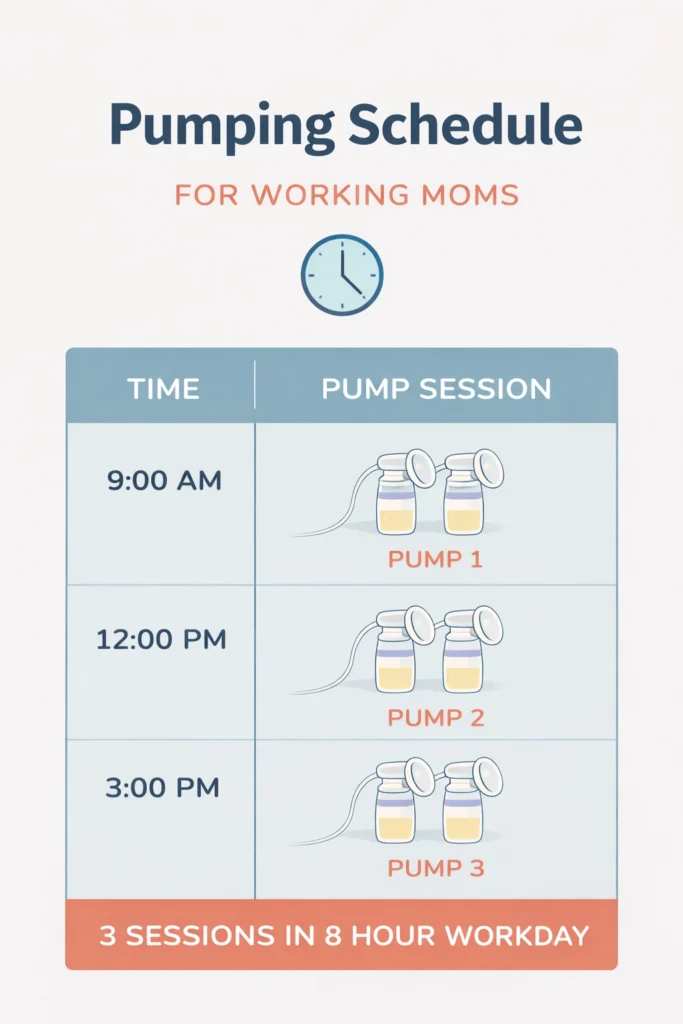
3 Realistic Pumping Schedules for Working Moms
If you’re still asking yourself how often should I pump at work, the answer becomes much clearer when you see it mapped out into real schedules.
Choose the schedule that matches your situation. Stick with it for one full week before adjusting — consistency matters more than perfection.
1️⃣ Office Job (9am–5pm)
For most moms working a standard office schedule, the answer to how often should I pump at work usually means every 2–3 hours, which translates to about three sessions during an 8-hour shift.
| Time | What to Do |
|---|---|
| 7:00am | Nurse baby OR pump at home before leaving |
| 10:00am | Pump at work (15–20 minutes) |
| 12:30pm | Pump at work ( during lunch period) |
| 3:00pm | Pump at work (mid-afternoon) |
| 6:00pm | Nurse baby when you get home |
3 sessions at work. Each takes 15–20 minutes with a double electric pump.
2️⃣ Shift Worker (12-Hour Shift — nurse, teacher, retail)
If you work longer shifts, you may wonder how often should I pump at work when breaks aren’t predictable?
The goal is still milk removal every 3 hours — even if sessions are slightly shorter.
| Time | What to Do |
|---|---|
| Before shift | Nurse or pump at home |
| 3 hours in | Pump (first break) |
| 6 hours in | Pump (mid-shift break) |
| 9 hours in | Pump (even 10 minutes helps) |
| After shift | Nurse baby at home |
Tip: A wearable pump is life-changing for shift workers — you can pump during a staff handover, in a break room, or anywhere with 10 minutes of privacy.
3️⃣ Work From Home
Working from home sounds easier — but it’s often harder to stay consistent because “just one more task” pushes sessions later and later.
If you’re thinking, how often should I pump at work when I’m technically at home?
The answer is the same: protect 2–3 hour intervals just like you would in an office.
Set phone alarms. Treat pumping sessions like back-to-back meetings — completely non-negotiable.
| Time | What to Do |
|---|---|
| 8:00am | Nurse baby (hand to childcare) |
| 10:30am | Pump alarm — step away from screen |
| 1:00pm | Pump alarm — lunch break |
| 3:30pm | Pump alarm — before afternoon work |
| 5:30pm | Nurse baby when childcare returns |
Why These Schedules Work
No matter your work setting, the principle behind how often should I pump at work is simple:
Milk must be removed consistently to protect supply.
Whether you’re in an office, hospital ward, classroom, or home office, your body responds to rhythm. Keep that rhythm steady — and your supply is far more likely to stay stable.
How Long Should Each Pumping Session Be?
- 15–20 minutes with a double electric pump
- Continue pumping for 2–3 minutes after milk slows — this signals your body to produce more next time
- Total break needed: 25–35 minutes (including walking to/from pump room, setup, and storage)
This matters when you speak to your manager. A 20-minute break sounds fine — but rushing raises cortisol, which directly reduces milk output. You need the full 25–35 minutes.

Your Legal Pumping Break Rights (UK + US + Canada)
This is what most pumping guides skip — and what you may need to show your manager.
🇬🇧 United Kingdom
Your employer has a legal duty of care for breastfeeding mothers. While there is no specific right to paid pumping breaks, employers must:
- Provide a private, clean space — a toilet is not acceptable
- Carry out a risk assessment for all breastfeeding employees on return to work
- Give reasonable consideration to adjusted breaks or flexible working requests
What to do: Email HR before your return date. Put your request in writing. Ask for a private space and 2–3 breaks per day. Most employers will accommodate — they just need to know it’s expected.
🇺🇸 United States
Under the PUMP Act (2022):
- Employers must provide reasonable break time to pump
- A private space that is not a bathroom is legally required
- Protections apply to most employees for up to one year after birth
- Coverage extends to most salaried workers previously excluded from the original FLSA protections (U.S. Department of Labor)
- The CDC also provides detailed guidance on pumping at work, workplace rights, and maintaining milk supply when returning to employment.
🇨🇦 Canada
Protections vary by province, but federally regulated workplaces must accommodate breastfeeding employees under human rights legislation. Many provinces have additional specific protections — check your provincial human rights code.
Remember: Knowing your rights reduces anxiety — and anxiety directly suppresses milk flow.
How to Maintain Your Milk Supply at Work
1 Never Skip Sessions Without a Plan
Consistency is more powerful than perfection. From my own experience — and from watching my cousin’s supply grow from barely anything to donation level — showing up every 2–3 hours is the single most effective thing you can do.
2 Add a Morning Pump Session
Prolactin — the hormone responsible for milk production — is naturally highest in the morning. A short extra pump after your baby’s first feed builds your freezer stash and reinforces supply signals.
3 Nurse as Much as Possible at Home
Evenings and weekends at the breast are your best supply protection. Your baby removes milk more efficiently than any pump — use that time fully.
4 Use Your Baby’s Photo or Voice to Trigger Let-Down
Keep a photo of your baby at your pump station or on your phone. Looking at it as you begin pumping can trigger let-down — especially in a stressful workplace environment.
5 Stay Hydrated and Eat Enough
According to the NHS guidance on expressing breast milk, regular milk removal and proper storage are essential for maintaining supply — especially when returning to work.
6 Build Your Freezer Stash Before Returning
Start one extra pump session per day 2–4 weeks before your return date. Even 20–30ml a day adds up quickly. Having a stash removes the pressure of “I have to pump enough today” — and lower pressure means better output.
Signs You’re Not Pumping Often Enough
Watch for these signals that your schedule needs adjusting:
- Breasts feel uncomfortably full or painful before your next session
- Milk supply starts dropping after 1–2 weeks back at work
- Baby seems frustrated or unsettled during evening nursing
- You’re leaking through your clothing regularly before pump time
If you notice these, temporarily add one extra session per day — try just before bed — for 3–5 days. Most moms see improvement quickly.
Best Pumps for Working Moms
Double Electric Pump — Most Effective
The gold standard for working moms. Pumps both breasts simultaneously, cutting session time in half. Look for: quiet motor, rechargeable battery, easy-clean parts.
Best for: Office workers with a private room and predictable breaks.
Wearable (Hands-Free) Pump — Best for Busy Schedules
Fits inside your nursing bra. You can pump at your desk, during a video call (camera off), or anywhere with a few minutes of privacy. Slightly less efficient than double electric but your hands are completely free.
Best for: Nurses, teachers, shift workers, work-from-home moms, open-plan offices.
What to Pack in Your Pump Bag:
- Pump + all parts
- Spare valves and membranes (they wear out — always carry spares)
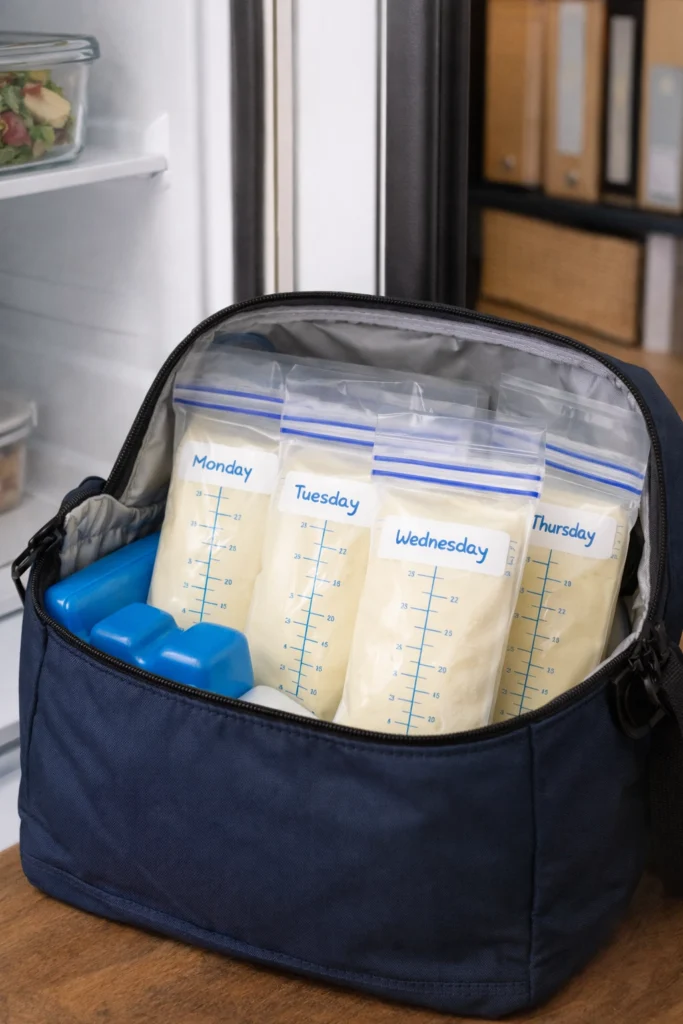
- Insulated cooler bag with ice packs
- Nursing pads (leaking happens)
- Hands-free pumping bra
- Labelled milk storage bags
- Large water bottle + snacks
- A photo of your baby
Mistakes That Kill Your Supply (Avoid These)
❌ Waiting until your breasts feel full before pumping
By the time your breasts feel full, your body has already received the signal to produce less milk. Pump regularly before fullness happens to maintain supply.
❌ Skipping sessions because meetings run over
Instead of pushing pumping later, schedule your session before meetings begin. Treat pumping like a non-negotiable appointment.
❌ Using the wrong flange size
Your nipple should move freely inside the flange tunnel without pulling the areola in. The wrong size can reduce output and cause unnecessary pain.
❌ Not replacing pump parts regularly
Valves and membranes wear out over time and quietly reduce suction. Replace them every 2–3 months with regular use.
❌ Comparing pump output to baby feeds
Babies remove milk far more efficiently than pumps. Lower pump output does not always mean low supply. Focus on wet nappies and healthy weight gain.
❌ Expecting quick results
Milk supply increases with consistency over days, not hours. Give any new schedule at least one week before judging results.
FAQ: How Often Should I Pump at Work?
How many times should I pump during an 8-hour shift?
If you’re wondering how often should I pump at work during an 8-hour shift, most moms need 2–3 sessions, depending on their baby’s age. Babies under 6 months generally need 3 sessions; older babies may manage well with 2
Can I pump only twice a day at work?
If your baby is over 6 months and your supply is stable, it may be possible — but monitor closely. Reducing sessions too quickly is the most common cause of supply drops when returning to work.
What if I miss a pumping session at work?
If you miss one session, don’t panic. Instead of doubling the next session, add an extra pump later that evening or just before bed. Consistency matters more than volume when deciding how often should I pump at work.
Is it normal to pump less at work than at home?
Yes — completely normal. Stress, unfamiliar surroundings, and time pressure all reduce output. Use your baby’s photo, stay warm, and give yourself the full session time.
My output is very low — does that mean I have low supply?
Not necessarily. I started with barely 20ml per session. My cousin started similarly. With consistent 3-hour sessions and a switch to a double electric pump, both our outputs improved significantly within days. Give a consistent schedule at least a full week before drawing conclusions.
When should I start preparing before returning to work?
2–4 weeks before your return date. Start one extra pump session per day to build a freezer stash and let your body adapt to the schedule you’ll follow at work.
Conclusion: You Are Doing Something Extraordinary
If how often should I pump at work brought you here — whether you’re returning next week or planning ahead — I want you to know something.
What you’re doing is not small.
You’re learning new logistics, advocating for your needs in a workplace not built for you, managing the guilt of leaving, and still choosing to give your baby breast milk through all of it. That deserves more acknowledgement than it gets.
When you’re asking yourself how often should I pump at work, what you’re really asking is:
“How do I protect my milk supply while protecting my career?”
I started my pumping journey with a manual pump, 20ml sessions, and a spiral of panic. My cousin started with almost nothing and ended up donating milk. Neither of us had a perfect body or perfect supply. We got there by showing up consistently — every 2–3 hours — even when it felt like it wasn’t working.
And that’s the real answer to how often should I pump at work:
Consistently. Protect your sessions. Trust the process.
Start here tonight:
- Set three phone alarms for your work pumping sessions
- Send one email to HR before your first day back
- Start your freezer stash this week — one extra pump per day
- Keep a photo of your baby at your pump station
The first two weeks back are the hardest. After that, routine forms. Confidence builds. What feels impossible right now becomes automatic.
Tiny progress still counts. Consistent sessions build supply. You can do this.
As you adjust to pumping at work and long nights, this sleep guide may help you feel less alone:
👉 Newborn Won’t Sleep Unless Held at Night
Disclaimer: This post is for general educational purposes only and is not medical advice. For personal breastfeeding support, speak with a lactation consultant (IBCLC), your GP, health visitor, or midwife.