

- My Real Experience With the 4-Month Sleep Regression
- Quick Answer: What Is Sleep Regression 4 Months?
- 7 Signs Your Baby Is in the 4-Month Sleep Regression
- How Long Does Sleep Regression 4 Months Last?
- When It Feels Like Regression… But It's Actually a "Night Owl Schedule"
- What Makes Sleep Regression 4 Months Worse
- When to Worry: Red Flags That Need a Doctor
- FAQ: Sleep Regression 4 Months
- The Emotional Reality: This Is One of the Hardest Phases
- Conclusion: You Will Get Through This
If you’re in the sleep regression 4 months phase, it can feel like your baby changed overnight.
One week they were sleeping in longer stretches. The next? Frequent wakings, short naps, unpredictable nights — and suddenly you’re surviving on broken sleep.
Some nights might still give you 5+ hours. Other nights it’s less than 2. And when your baby stays awake until 3am, 5am, or even 6am, it can feel like their entire schedule flipped upside down.
You’re exhausted. You’re confused. And you’re wondering: Is this normal? Did I do something wrong?
You didn’t.
In this guide, I’ll explain:
- What’s actually happening during the sleep regression 4 months
- How long it typically lasts
- The 7 most common signs
- And 9 gentle, realistic fixes that actually help
My Real Experience With the 4-Month Sleep Regression
I used to hear, “After 4 months, babies sleep better.”
That wasn’t my experience.
Some nights my baby sleeps 5+ hours. Other nights she wakes every 90 minutes. Feeding her back to sleep doesn’t always work anymore. And on the hardest nights, she doesn’t fully settle until 5am… sometimes even 6am.
Sometimes she does fall asleep — and then suddenly wakes up crying loudly, like something startled her. My parents even told me, “Maybe she forgot how to sleep.” Hearing that made me panic. I didn’t know how to help her.
I kept breastfeeding, rocking, trying everything… but sleep still wouldn’t come. There were nights I truly didn’t know what else to do.
I’ve rocked her in the dark while eating crackers at 3am because I was too hungry to ignore it. I’ve watched the sun rise while everyone else started their morning — and we were only just going to bed.
And I won’t lie — I was exhausted. Not just sleepy. Physically drained. Mentally overwhelmed.
If you’re in that phase right now — the backwards schedule, the exhaustion, the “why is this happening?” spiral — I see you.
This guide is the roadmap I wish I had during those nights.
Quick Answer: What Is Sleep Regression 4 Months?
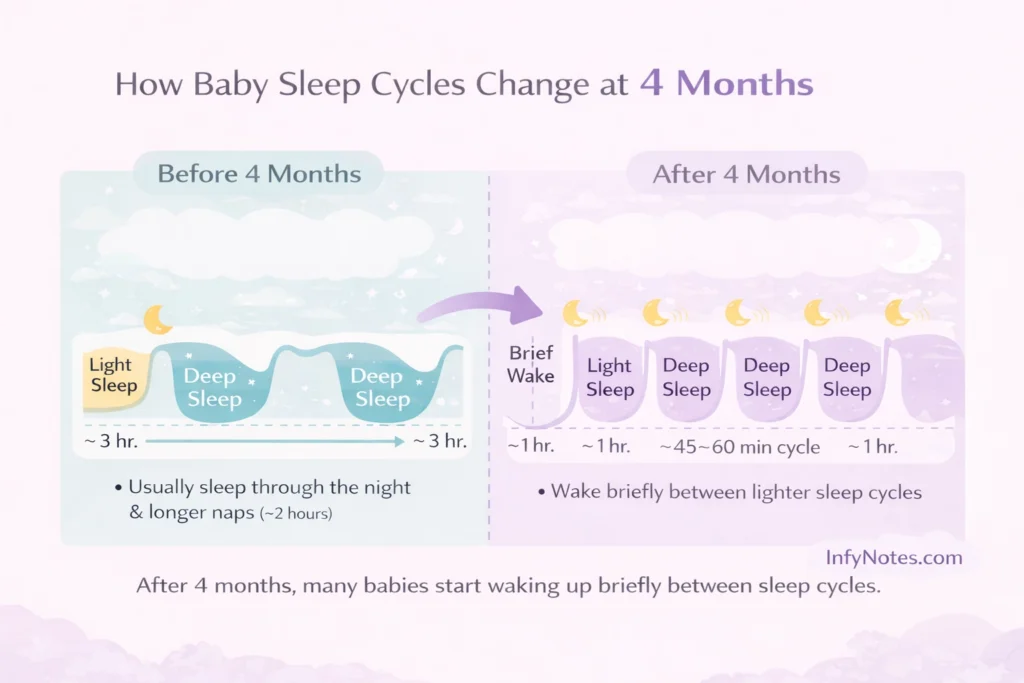
Sleep regression 4 months is a permanent developmental change in your baby’s sleep patterns that typically happens between 3-5 months of age.
Here’s what changes:
Before 4 months:
- Babies have 2 simple sleep stages
- Sleep cycles are 45-60 minutes
- They can sleep through noise and light easily
After 4 months:
- Babies develop 4 sleep stages (like adults)
- Sleep cycles become 60-90 minutes
- They wake briefly between cycles
- They’re more aware of their environment
The “regression” happens when babies wake at the end of each cycle and haven’t yet learned to fall back asleep on their own — so they fully wake up and cry for help. (Sleep Foundation)
This sleep maturation is permanent. Your baby’s sleep has changed forever — they’ll never go back to newborn sleep patterns. But the difficult wakings and sleep struggles typically last 2-6 weeks once you establish consistent routines. (Healthline)
7 Signs Your Baby Is in the 4-Month Sleep Regression
If you’re seeing 3 or more of these signs, you’re likely in it:
1. Frequent Night Wakings (Every 1-2 Hours)
Your baby wakes like clockwork — often every 60-90 minutes — and needs help settling back to sleep.
Why it happens: They’re waking at the end of each sleep cycle and don’t know how to fall back asleep independently yet.
2. Short Naps (30-45 Minutes)
Your baby wakes after one sleep cycle and can’t connect to the next one.
Why it happens: Same issue as nighttime — waking between cycles without the skill to resettle.
3. Suddenly Fighting Sleep at Bedtime
Even with your usual bedtime routine, your baby protests sleep much harder than before.
Why it happens: They’re more aware of the world now and don’t want to miss anything. Plus, overtiredness from disrupted sleep makes falling asleep even harder.
4. Only Sleeps When Held (Or Wakes When Put Down)
Your baby used to sleep in the cot, but now they wake the moment they touch the mattress.
Why it happens: They’ve developed a strong sleep association with being held. When they wake between cycles and find themselves alone, they fully wake up scared or confused.
If your baby is younger than 3 months and showing this pattern, this post might help: Newborn Won’t Sleep Unless Held at Night? 9 Gentle Fixes That Work
5. Feeding More at Night (Even If Daytime Feeds Are Fine)
Your baby wants to nurse or bottle-feed constantly at night, even though they’re eating well during the day.
Why it happens: Feeding has become a sleep association. They’re not necessarily hungry every hour — they’re seeking the comfort of feeding to fall back asleep.
6. Early Morning Wake-Ups (Or Very Late “Bedtimes”)
Your baby either wakes before 6am and won’t go back to sleep, or they stay awake until 3-6am and treat that as “bedtime.”
Why it happens: Their body clock (circadian rhythm) needs resetting. This often happens when daytime sleep is too long or too late, pushing nighttime sleep later and later.
7. Can’t Be Put Down “Drowsy But Awake” Anymore
You used to be able to put your baby down calm but awake. Now they scream the instant they’re in the cot.
Why it happens: They’ve lost the ability to self-soothe that some newborns have naturally. They need to learn this skill again with their new mature sleep cycles.
How Long Does Sleep Regression 4 Months Last?
The permanent sleep cycle change: Forever. Your baby will never return to newborn sleep patterns.
The difficult wakings and sleep struggles: Typically 2-6 weeks.
Here’s the breakdown:
Best case: 2-3 weeks if you establish consistent routines quickly Average: 3-4 weeks for most babies Can last longer: 6+ weeks (or even months) if:
- Baby is consistently overtired (wake windows too long)
- Baby has very strong sleep associations (must be fed/rocked/held to sleep)
- Baby’s body clock is flipped (more daytime sleep → awake all night)
- Inconsistent responses at night (trying different methods every time)
Important: If your baby is awake until 3-6am regularly, that’s often not typical regression — it’s a body clock issue that needs gentle resetting (see Fix #1 and Fix #2 below).
When It Feels Like Regression… But It’s Actually a “Night Owl Schedule”
If your experience matches mine — baby awake until 3am, 5am, even 6am while everyone else is starting their day — this is often a circadian rhythm disruption, not just typical regression.
This happens when:
- Baby gets too much daytime sleep (especially late afternoon naps)
- Mornings start late (sleeping in shifts the whole day later)
- Nights become stimulating (lights, play, talking at 2-5am)
- There’s no consistent morning wake time to anchor the body clock
Good news: You can gently reset this. It takes 5-7 days of consistency, but it works.
What Makes Sleep Regression 4 Months Worse
❌ Overtiredness
When wake windows stretch too long between naps, cortisol (the stress hormone) rises — making it harder for your baby to fall asleep and stay asleep.
❌ Undertiredness (Too Much Daytime Sleep)
If your baby sleeps too long during the day or takes a late afternoon nap, they may not be tired enough at bedtime — leading to long periods awake at night.
❌ Inconsistent Responses at Night
Trying different soothing methods every wake-up (rocking one time, feeding another, co-sleeping out of desperation the next) can confuse your baby and make it harder for them to learn what to expect.
❌ Bright Lights or Play at Night
If your baby wakes at 3am and you turn on lights, talk, make eye contact, or let them play, their brain may start to think: “Night is interesting. This is daytime.”
❌ Feeding to Sleep Every Single Wake
Sometimes necessary — but if feeding becomes the only way your baby can fall asleep, they may wake more frequently and expect it every single time.

9 Proven (Gentle) Fixes for Sleep Regression 4 Months
Tap a piece to jump to that fix
Fix #1: Set One Consistent Morning Wake Time (Body Clock Anchor)
This is the single most powerful fix for night owl babies.
If your baby sleeps until late morning (or goes to bed at 5-6am and wakes at noon), their entire day is shifted — and so is their night.
What to do:
- Pick one wake time (example: 7:00-8:00am)
- Keep it within 30 minutes every single day for 7 days
- Open curtains immediately
- Get 10-15 minutes of daylight exposure (by a window, on a balcony, or outside)
- Keep mornings bright and active
Why it works: Your baby’s body clock needs a consistent “start signal” every day. Morning light is the strongest circadian cue. Within 5-7 days, bedtime will naturally shift earlier.
This is how you fix 5am bedtimes.
Fix #2: Make Nights Boring (Even If Baby Is Wide Awake)
If your baby wakes at 3am and wants to play, you need to teach them: night = sleep time, not play time.
What to do:
- Use only dim red light (or very low lighting)
- No talking, singing, or eye contact games
- Feed/soothe quietly and calmly
- No screens, bright lights, or stimulation
- Put baby back in sleep space even if they’re awake
Why it works: When nights are boring, baby’s brain stops finding them interesting. Combined with Fix #1, this resets the body clock faster.
Fix #3: Follow Age-Appropriate Wake Windows
At 4 months, most babies handle 1.5-2 hours of awake time between naps (sometimes up to 2.25 hours before bedtime).
Sample schedule (adjust to your baby):
- Wake: 7:30am
- Nap 1: 9:00-10:00am (1 hour)
- Nap 2: 12:00-1:15pm (1 hour 15 minutes)
- Nap 3: 3:15-4:00pm (45 minutes)
- Bedtime routine: 6:00pm
- Asleep by: 7:00-7:30pm
If naps are very short, you may need a 4th catnap (15-30 minutes around 5:30pm) temporarily to avoid overtiredness before bed.
Why it works: Well-rested babies fall asleep easier. Overtired babies have elevated cortisol and fight sleep harder.
Fix #4: Create a Predictable Bedtime Routine (15-30 Minutes)
Consistency signals to your baby’s brain that sleep is coming.
Simple routine example:
- Bath (optional — not every night)
- Fresh nappy
- Sleep sack
- Feed in dim lighting (try not to let baby fall fully asleep on you every single time)
- Short song or lullaby
- White noise on
- Into cot calm (drowsy but awake when possible)
Keep it simple and repeatable. Consistency beats perfection.

Fix #5: Optimize the Sleep Environment
Your baby’s sleep space should support deep, connected sleep cycles.
Aim for:
- Dark: Blackout curtains or blackout blinds (even a crack of light can wake them during light sleep stages)
- Cool: 16-20°C / 68-72°F (overheating disrupts sleep)
- White noise: Continuous (not music that stops) at 50-60 decibels
- Safe: Empty cot, firm mattress, baby on back (AAP safe sleep guidelines)
Fix #6: Choose ONE Settling Method and Stick to It (7-10 Days)
Pick a method that feels doable for you and commit to it for at least a week. Consistency is more important than the specific method.
Option A: Gradual Fading (Gentle + Realistic)
- Soothe your baby as you normally do
- Each night, put them down slightly earlier in the falling-asleep process
- Use patting/shushing if they fuss
- Over 7-10 nights, they get used to falling asleep with less help
Option B: Pick-Up / Put-Down
- Put baby down calm in the cot
- If they cry, pick them up to calm them
- Once calm, put them back down
- Repeat as many times as needed
Why one method matters: Changing your approach every night (rocking one night, nursing the next, co-sleeping the third) confuses your baby and extends the regression.
Fix #7: Handle Night Feeds With a Simple Rule
At 4 months, most babies still need 1-2 night feeds. Don’t try to eliminate all feeds — just reduce “comfort feeds every hour.”
Simple guideline:
- If it’s been 3+ hours since the last feed → feed
- If it’s been less than 3 hours → try soothing for 3-5 minutes first (pat, shush, pick up if needed)
- If baby is genuinely upset after 5 minutes, go ahead and feed
Why it works: This reduces hourly comfort feeds without forcing full night-weaning (which isn’t developmentally appropriate yet for most babies).
If you’re a working mom pumping during the day, your daytime feeding schedule can impact night wakings too. Read: How Often Should I Pump at Work? A Simple Schedule for Working Moms
Fix #8: Use Rescue Naps (So Baby Isn’t Overtired)
You don’t have to practice independent sleep for every single nap right now.
Strategy:
- Pick one nap per day to practice cot naps (usually the first morning nap)
- For other naps, do what works: carrier, stroller, contact nap, even feeding to sleep
Why it works: An overtired baby sleeps worse at night, not better. Getting enough total daytime sleep (even if it’s “imperfect”) protects nighttime sleep.
Fix #9: Ask for Help (Because This Phase Is Heavy)
Your words — “stressed, tired, helpless, hungry at night” — are real, and they matter.
Sleep deprivation at this level is genuinely dangerous for your physical and mental health.
Even small help makes a difference:
- Partner takes one shift (10pm-2am or first wake-up)
- Someone holds baby for a 60-90 minute nap so you can sleep
- Order takeaway for dinner for a week
- Let the laundry pile up
- Accept any offer of help
Survival > perfection.
If you’re also managing other postpartum challenges on top of sleep deprivation, you’re not alone: Postpartum Hair Loss Timeline: When It Starts, Peaks & Stops
When to Worry: Red Flags That Need a Doctor
Sleep regression 4 months is normal and common. But sometimes other issues masquerade as sleep regression.
Call your GP, health visitor, or pediatrician if:
Fever or Unwell
Your baby has a fever or seems generally unwell.
Poor Weight Gain
They’re not gaining weight appropriately for their age.
Breathing Concerns
You hear snoring, gasping, or pauses in breathing during sleep.
Pain When Lying Down
Your baby seems uncomfortable when placed flat (possible reflux or ear infection).
Lasts Over 6 Weeks
Sleep disruption continues longer than 6 weeks despite consistent routines.
Excessive Day Sleepiness
Your baby is unusually sleepy during the day beyond age-appropriate naps.
FAQ: Sleep Regression 4 Months
When does sleep regression 4 months start?
The sleep regression 4 months typically begins between 3–5 months of age. Some babies show changes as early as 3 months, while others don’t experience it until closer to 5 months. This timing depends on when their sleep cycles permanently mature.
How long does sleep regression 4 months last?
The difficult phase usually lasts 2-6 weeks. The permanent change in sleep cycles is forever, but the challenging wakings improve with consistent routines.
Is it normal for my 4-month-old to wake every hour?
Yes. During sleep regression 4 months, waking frequently can be common because baby sleep cycles are often around 40–60 minutes (sometimes longer at night as they mature). Once they start linking sleep cycles independently, longer stretches gradually return.
Should I stop feeding at night during the regression?
No. At 4 months, most babies still need 1-2 night feeds. Focus on reducing hourly comfort feeds, not full night-weaning.
Why are naps suddenly so short (30-45 minutes)?
Because naps often stay lighter at this age and babies wake between sleep cycles. Many babies lengthen naps later (around 5-7 months) with practice and routine.
What if my baby only sleeps when held?
Very common during regression. Use gradual changes (Fix #6) and protect your own rest with rescue naps. This post can help too: Newborn Won’t Sleep Unless Held at Night? 9 Gentle Fixes That Work
Can I prevent the 4-month sleep regression?
No. This is a biological developmental milestone. However, establishing good sleep habits before 4 months can make it less disruptive.
The Emotional Reality: This Is One of the Hardest Phases
Sleep regression 4 months is brutal.
You finally felt like you were getting somewhere. You’d found a rhythm. You were sleeping in longer stretches. You felt almost human again.
And then it all fell apart overnight.
I remember standing in my daughter’s room at 5am — not 5am wake-up, but 5am bedtime — feeling so exhausted I could barely stand. Watching everyone else start their day while I was just putting my baby down to sleep.
Here’s what I wish someone had told me:
This is temporary. Even when it feels endless at 4am when you’ve been awake all night.
You’re not failing. This is not your fault. This is brain development, not bad parenting.
It’s okay to just survive. Perfect sleep routines, “drowsy but awake,” independent sleep — those are goals to work toward, not requirements for tonight.
Do what you need to do to get through this phase. Feed to sleep if that’s what works. Rock for an hour. Bedshare safely if that’s the only way anyone sleeps. Hold for naps. Whatever keeps everyone sane.
Once you’re through the worst of it, then you can gently work on independent sleep skills.
Right now? Survival mode is not just acceptable — it’s smart.
Conclusion: You Will Get Through This
If sleep regression 4 months brought you here at 3am — or 5am, or when you’re about to go to bed as everyone else wakes up — I want you to know:
- This is a developmental milestone, not something you caused
- It typically lasts 2-6 weeks (not forever)
- The 5am bedtime/night owl pattern can be gently reset
- Consistency, good sleep environment, and age-appropriate schedules help
- It’s okay to prioritize survival over perfect routines right now
You will sleep again.
The nights will get better. Your baby will learn to connect sleep cycles. You’ll look back on this as a blur — but a blur that ended.
For tonight:
- Stick to your bedtime routine
- Make nights boring (dim lights, no play)
- Set a consistent morning wake time for tomorrow
- Ask for help if you have it
- Sleep when your baby sleeps
You’ve got this. And more importantly — you’re not alone in this.
Disclaimer: This post is for educational purposes only and is not medical advice. For concerns about your baby’s sleep, health, or development, consult your GP, health visitor, or pediatrician. Always follow safe sleep guidelines.