
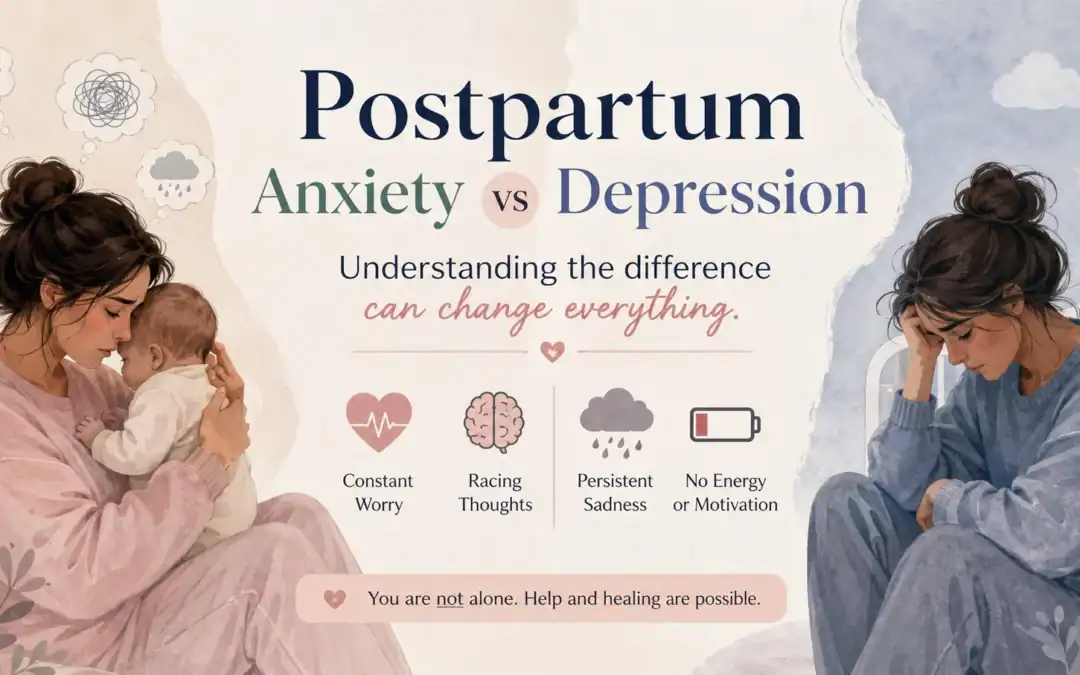
- When Something Feels Wrong After Baby — But You Can't Explain It
- A Personal Note From My Own Postpartum Experience
- What Is Postpartum Anxiety? (More Than Just Worry)
- What Is Postpartum Depression? (It's Not Just Sadness)
- Postpartum Anxiety vs Depression: Side-by-Side Comparison
- How Do You Know Which One You Have? (Or Both?)
- Practical Steps to Start Feeling Better — Starting Today
- Expert Tips: What Mental Health Professionals Want You to Know
- Mistakes to Avoid When Dealing With Postpartum Anxiety or Depression
- FAQs: Postpartum Anxiety vs Depression
- You Are Not Broken — You Are a Mum Who Needs Support
When Something Feels Wrong After Baby — But You Can’t Explain It
You just had a baby. Everyone says you should be overjoyed. But instead, your mind is racing at 3 a.m. imagining terrible things happening to your newborn. Or you’re dragging yourself through every feed, every nappy change, feeling hollow — like you’re watching your own life through foggy glass.
You’ve probably Googled ‘is this normal?’ more times than you can count. And somewhere in that search, you came across the terms postpartum anxiety vs depression — and now you’re wondering: which one do I have? Or could it be both?
You are not alone. You are not failing. And the fact that you’re asking these questions means you’re already taking the most important step. In this post, we’re going to break down postpartum anxiety vs depression clearly and honestly — not in clinical language that leaves you more confused, but in real, mama-to-mama terms that actually help.
A Personal Note From My Own Postpartum Experience
After becoming a mum, I realised that postpartum anxiety vs depression do not always look the way people expect.
I loved my baby deeply and felt happiest when I was with her — but at the same time, my mind never truly rested. I constantly worried that something bad might happen to my baby or my husband. Even small comments from other people would stay in my mind for hours, and I often found myself overthinking everything.
There were days I questioned whether I was doing enough as a mother. If someone casually commented about my baby’s appearance or feeding, I immediately felt guilty and wondered if my breast milk was enough or if I was somehow failing my child.
One of the hardest parts was trying to balance motherhood with everyone else’s expectations. Some people expected me to return to work quickly, while others questioned why I could not manage household chores perfectly.
But caring for a baby around the clock is exhausting in ways many people do not fully understand — especially when sleep disappears completely.
My baby often slept very late at night, sometimes not until 4 or 5 a.m. I stayed awake caring for her, then slept later in the morning to recover, only to feel judged for that too.
At the same time, my husband and I slowly lost the free time and connection we once had, because every moment became divided between baby care, housework, and responsibilities.
What hurt most was feeling like after the baby arrived, everyone focused on the baby — but very few people asked how I was doing.
That experience taught me something important: postpartum anxiety and depression do not mean you are weak, ungrateful, or a bad mother. Sometimes they are simply the result of carrying too much for too long without enough rest, support, or understanding.
What Is Postpartum Anxiety? (More Than Just Worry)
Most people have heard of postpartum depression, but postpartum anxiety is actually more common and far less talked about. Studies suggest it affects up to 18% of new mothers — and many experts believe even that number is under-reported.
Postpartum anxiety is an excessive, persistent feeling of worry, fear, or dread that develops after childbirth. It’s not just the normal new-parent nervousness. It’s the kind of anxiety that hijacks your brain, makes it nearly impossible to switch off, and often focuses on fears about your baby’s safety or your ability to cope. Sound familiar? I lived that reality — the relentless ‘what ifs’, the inability to sleep even when the baby finally did.
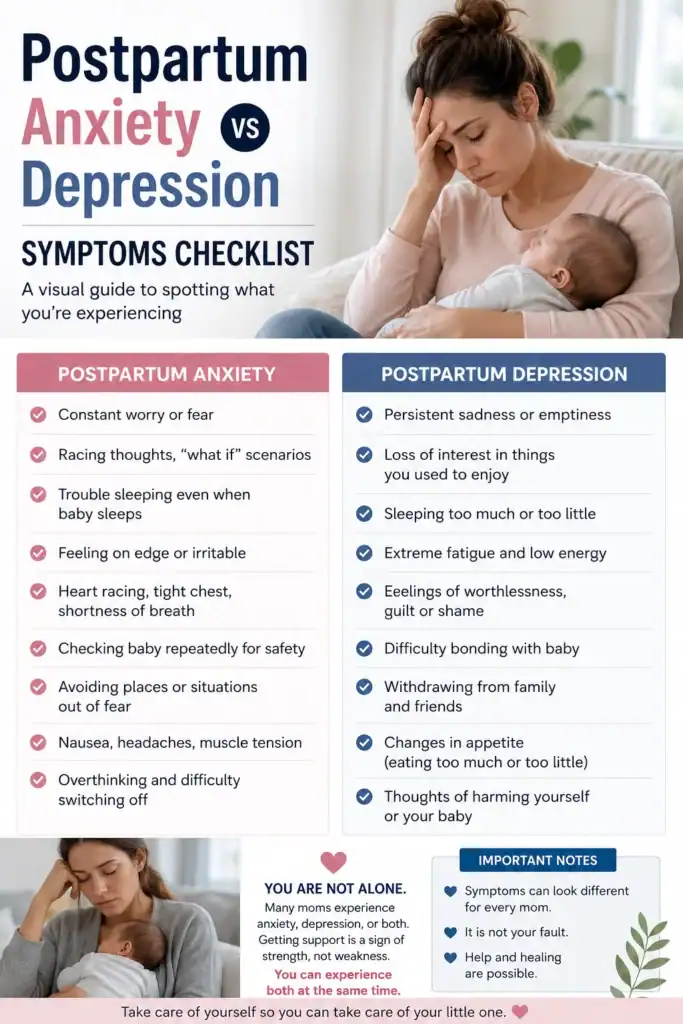
Common Postpartum Anxiety Symptoms
- Constant, intrusive ‘what if’ thoughts — What if the baby stops breathing? What if I drop her?
- Inability to sleep even when the baby is asleep
- Racing heart, tight chest, or shortness of breath
- Feeling on edge or irritable all the time
- Checking the baby repeatedly (breathing monitor every 10 minutes)
- Avoiding situations out of fear (refusing to drive with the baby, avoiding crowds)
- Physical symptoms — nausea, headaches, muscle tension
Postpartum anxiety can also overlap with postpartum OCD (intrusive thoughts and compulsive behaviours) and postpartum PTSD (especially after a traumatic birth). These thoughts do not make you a bad mum. They are symptoms of an illness — not a reflection of who you are.
What Is Postpartum Depression? (It’s Not Just Sadness)
Postpartum depression (PPD) is one of the most common complications of childbirth, affecting approximately 1 in 7 mothers worldwide. Despite how common it is, it’s wildly misunderstood — often confused with the ‘baby blues’ (which is temporary and resolves within 2 weeks) or dismissed as a personality flaw.
PPD is a serious mood disorder that can begin any time within the first year after birth. It’s caused by a combination of hormonal shifts, sleep deprivation, identity changes, and in some cases a predisposition to depression. What I experienced leaned more toward the anxiety end — but there were absolutely days of deep emptiness too, especially when the isolation and judgement piled up.
Common Postpartum Depression Symptoms
- Persistent sadness, crying spells, or feeling empty
- Loss of interest in things you used to enjoy
- Difficulty bonding with your baby — feeling disconnected or detached
- Extreme fatigue and lack of motivation
- Changes in appetite — eating too much or barely eating
- Feelings of worthlessness, guilt, or shame
- Withdrawing from family and friends
- In severe cases: thoughts of harming yourself or your baby (seek help immediately)
If you’re experiencing any of the more severe symptoms, please reach out to your GP, midwife, or a mental health helpline today. In the UK: PANDAS Foundation on 0808 1961 776. In the US: Postpartum Support International at 1-800-944-4773.
Postpartum Anxiety vs Depression: Side-by-Side Comparison
When trying to understand postpartum anxiety vs depression, this comparison can help clarify which symptoms align with which condition:
| Feature | Postpartum Anxiety | Postpartum Depression |
|---|---|---|
| Primary feeling | Fear, worry, dread | Sadness, emptiness, numbness |
| Sleep issues | Can't sleep due to worry | Sleep too much or too little |
| Physical signs | Racing heart, tight chest | Fatigue, body aches |
| Thoughts | Catastrophic 'what ifs' | Hopelessness, worthlessness |
| Bonding | Hyper-alert, over-protective | Detached, disconnected |
| Timing | Often begins immediately | Usually 2–8 weeks postpartum |
| Can occur together? | Yes — very common | Yes — very common |
One crucial thing to note: postpartum anxiety and depression can and frequently do occur together. Research suggests that up to 50% of women with PPD also have significant postpartum anxiety — which, looking back, makes a lot of sense given what I and so many mamas have experienced.
How Do You Know Which One You Have? (Or Both?)
Here’s the honest truth: you can’t self-diagnose postpartum anxiety vs depression with certainty, and you shouldn’t have to. That’s your doctor’s job. But what you CAN do is start paying attention to which cluster of symptoms feels most like your daily experience.
Ask Yourself These Questions
- When you wake up, is your first feeling dread and worry, or sadness and emptiness?
- Do you feel wired and on high alert, or flat and disconnected?
- Are you overthinking worst-case scenarios, or feeling like nothing matters?
- Is your sleep disrupted by racing thoughts, or are you sleeping too much and still exhausted?
For me, it was the racing thoughts and the worry about everyone else — classic postpartum anxiety. But the guilt, the sense of not measuring up, the heaviness of feeling unseen? That touched on postpartum depression too. Both conditions deserve treatment. Both are real. And both can be addressed with the right support.
Practical Steps to Start Feeling Better — Starting Today
1. Talk to Your GP or Midwife
This is step one, full stop. Be honest about what you’re experiencing. Many mums minimise their symptoms because they feel guilty or fear judgement. Write down your symptoms before the appointment if it helps. Your healthcare provider can administer validated screening tools like the Edinburgh Postnatal Depression Scale (EPDS) which catches both anxiety and depression.
2. Accept That You Cannot ‘Think Your Way Out’ of This
Both postpartum anxiety and postpartum depression are medical conditions — not mindset problems. Telling yourself to ‘be positive’ won’t rewire the neurological and hormonal changes happening in your body. I tried that. It doesn’t work. Proper support does.
3. Ask for Specific Help — Not Just General Support
Instead of ‘let me know if you need anything,’ tell your partner, mum, or friend: ‘Can you take the baby for two hours so I can sleep?’ Specific requests get results. One of the loneliest parts of my postpartum experience was feeling like no one truly checked on me — so please, don’t wait for people to ask. Tell them what you need.
4. Reduce Anxiety Triggers Where Possible
If the news makes your anxiety spiral, turn it off. If social media comparisons bring on low mood, log out. Protecting your mental environment is not avoidance — it’s a boundary. I learned this slowly, and it made a real difference.
5. Try Evidence-Based Therapies
- CBT (Cognitive Behavioural Therapy) — proven effective for both postpartum anxiety and depression
- EMDR — especially helpful if birth trauma is involved
- Mindfulness-Based Cognitive Therapy (MBCT) — gentle, evidence-backed, and accessible online
The NHS offers talking therapies through IAPT — you can self-refer at nhs.uk/mental-health/talking-therapies.
If sleep deprivation is making your anxiety or low mood worse (and it almost certainly is — my baby slept past 4 a.m. for weeks), our guide on Sleep Regression 4 Months: 9 Proven Fixes + 7 Signs is incredibly helpful. Because exhausted mamas cannot heal.
Expert Tips: What Mental Health Professionals Want You to Know
- ‘Early treatment leads to faster recovery.’ The sooner you seek help for postpartum anxiety or depression, the sooner you can start feeling like yourself again.
- ‘Medication is not a last resort.’ Antidepressants and anti-anxiety medications are safe for breastfeeding in most cases. Discuss the options with your doctor without shame.
- ‘Your baby needs you well, not just present.’ A mum who seeks treatment for postpartum anxiety or depression is modelling extraordinary self-care and strength.
- ‘Postpartum anxiety and depression affect fathers too.’ Paternal postpartum depression is real — affecting up to 10% of new fathers. If your partner seems withdrawn or overwhelmed, encourage them to seek support too. My husband and I both felt the strain — and acknowledging that together helped enormously.
For a deeper clinical overview, the American Psychological Association’s guide on perinatal depression and anxiety is a well-researched, accessible resource worth bookmarking.
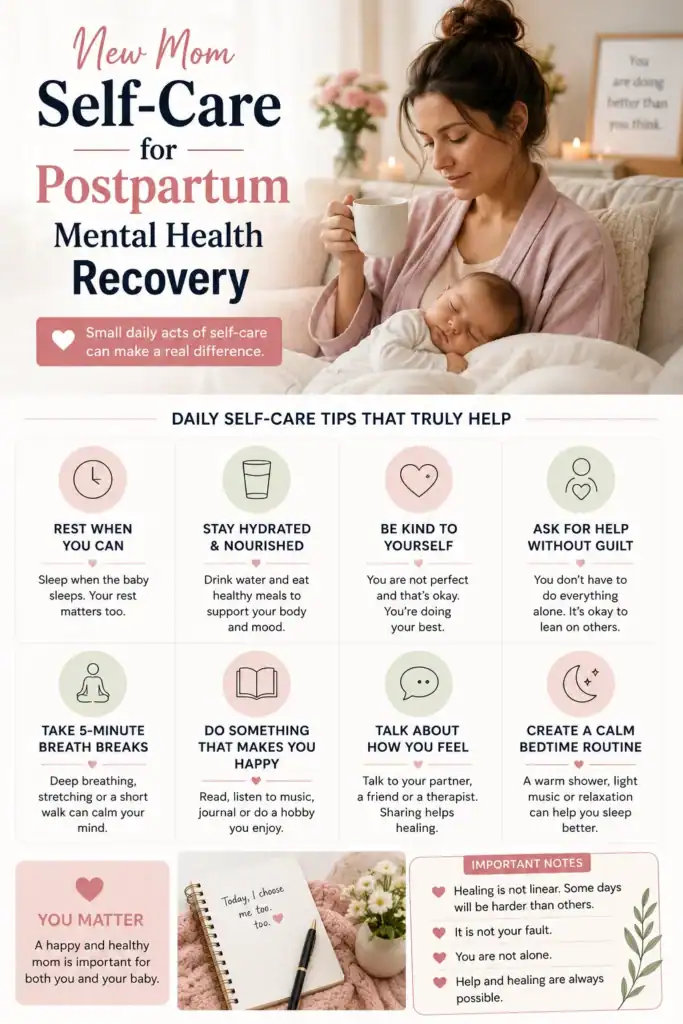
Mistakes to Avoid When Dealing With Postpartum Anxiety or Depression
- Waiting for it to ‘pass on its own.’ Baby blues resolve within two weeks. If symptoms persist beyond that, please don’t wait — reach out. I wish I had sooner.
- Comparing yourself to other mums. Social media is a highlights reel. The mum who looks perfect online may be struggling just as much as you are.
- Isolating yourself. Loneliness amplifies both postpartum anxiety and depression. Even a short video call with a friend can shift your nervous system state.
- Caffeine overload. That fifth coffee might be keeping you upright, but it’s also fuelling anxiety. Try to stay under 200mg per day.
- Dismissing physical symptoms. Chest tightness, nausea, and headaches can all be anxiety — not ‘just’ tiredness. Mention them to your GP.
- Not telling your partner how bad it really is. Vulnerability is not weakness — it’s connection. My husband could not support what he couldn’t see.
Returning to work while managing postpartum mental health? Our guide Going Back to Work After Baby UK: The Complete Survival Guide for Working Mums covers the emotional and practical aspects of transitioning back — including how to recognise when you need extra support.
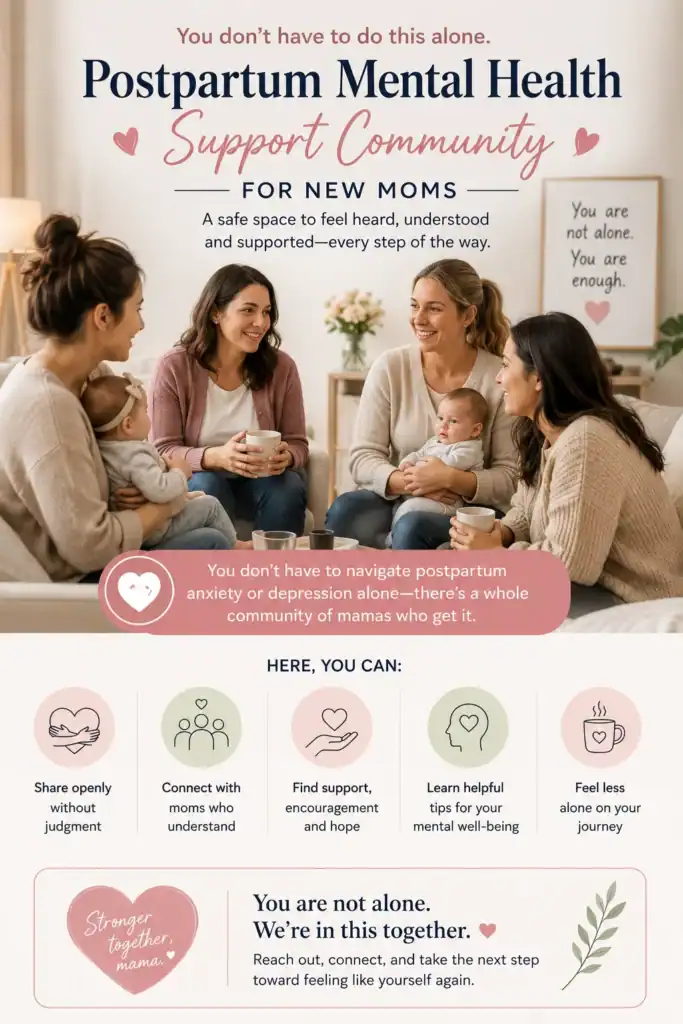
FAQs: Postpartum Anxiety vs Depression
Q: How long does postpartum anxiety vs depression last?
Without treatment, both conditions can last months or even years. With proper support — therapy, medication, lifestyle changes — most mums see significant improvement within 3–6 months. Early treatment leads to faster recovery.
Q: Can you have postpartum anxiety and depression at the same time?
Absolutely. When it comes to postpartum anxiety vs depression, many mums are surprised to learn that both conditions can happen at the same time. Research shows up to half of women with postpartum depression also experience significant anxiety. If you’re unsure which symptoms fit postpartum anxiety vs depression, describe everything you’re experiencing to your doctor — they’ll help guide you toward the right support.
Q: Is postpartum anxiety more common than postpartum depression?
Actually, yes. In discussions around postpartum anxiety vs depression, anxiety is often overlooked even though it may be slightly more common. Postpartum anxiety affects around 18% of new mothers, compared to roughly 15% for postpartum depression. It’s also more underdiagnosed because anxiety can look like “just being a worried mum.”
Q: Can postpartum anxiety or depression affect breastfeeding?
Yes. Both conditions can interfere with milk supply, letdown reflex, and the motivation to breastfeed. If you’re struggling with breastfeeding and also experiencing mental health symptoms, tell your midwife or lactation consultant.
Q: Will I be judged or have my baby taken away if I tell my doctor?
This fear stops so many mums from getting help — and it’s largely unfounded. Healthcare professionals are trained to support you, not punish you. Seeking help is evidence of good parenting. In almost all cases, treatment keeps families together.
Q: What’s the difference between baby blues and postpartum depression?
One important part of understanding postpartum anxiety vs depression is knowing the difference between baby blues and postpartum depression. Baby blues affect up to 80% of new mothers and usually peak around days 3–5 after birth, resolving on their own within 2 weeks. Postpartum depression is more severe, lasts longer, and requires proper treatment. If symptoms continue past the two-week mark, speak to your GP.
You Are Not Broken — You Are a Mum Who Needs Support
Understanding the difference between postpartum anxiety vs depression is the first step — and you’ve just taken it. Whether you’re wired with worry or weighed down by emptiness (or battling both at once), know this: what you’re experiencing has a name, a cause, and a solution.
I lived it. The sleepless nights not because of my baby, but because of my own racing mind. The guilt over questions I never expected to ask myself. The loneliness of being surrounded by people who were focused on the baby while I quietly wondered if I was okay. And I came out the other side — not because I was strong, but because I finally stopped pretending I was fine.
Postpartum anxiety and depression are incredibly common, real medical conditions — and they are treatable. Don’t wait until you’re drowning to reach out. Talk to your GP this week. Text a friend right now. Join a local or online mum support group.
For UK-specific mental health resources, Postpartum Support International (postpartum.net) provides a global helpline directory, support groups, and a provider directory — including specialists in the UK, US, and Canada.
One unexpected stressor in the postpartum period that caught me off guard? Hair loss. It adds to the feeling that your body is completely out of control. Our post Postpartum Hair Loss Timeline: When It Starts, Peaks & Stops breaks down exactly what to expect and what actually helps.
You deserve to feel well. Your baby deserves a mum who has been given the support she needs. And the first brave step? Is the one you’re already taking by learning about postpartum anxiety vs depression and refusing to stay silent.
Medical Disclaimer
This article is for informational and educational purposes only and is not intended to replace medical advice, diagnosis, or treatment from a qualified healthcare professional. Postpartum anxiety and depression can affect every mother differently. If your symptoms feel overwhelming, persist beyond two weeks, or include thoughts of harming yourself or your baby, please seek immediate support from your GP, midwife, mental health professional, or emergency services. You deserve support, care, and proper treatment.
💬 Have you experienced postpartum anxiety vs depression? Share your story in the comments — your words might be exactly what another mama needs to hear today.