

- Why Is My Baby Crying After Feeding? (The Short Answer)
- The Night I Learned That Every Cry Is Not Hunger
- 8 Common Reasons for Baby Crying After Feeding
- Research-Informed Tips to Reduce Baby Crying After Feeding
- Mistakes to Avoid When Your Baby Cries After Feeding
- FAQ: Baby Crying After Feeding
- You're Doing Better Than You Think
You just fed your baby. They should be settled, maybe even drifting off. Instead, they’re crying — a proper, full-lungs cry that makes your heart sink because you have no idea what just went wrong. If you’re dealing with a baby crying after feeding and feeling like you’re failing at the one thing you’re supposed to have figured out, this post is for you.
Baby crying after feeding is one of the most common concerns new parents bring to health visitors and paediatricians. It doesn’t mean you’re doing something wrong — it means your baby has a reason, and most of the time it’s something you can actually help with once you know what to look for.
This post walks through eight common causes, what each one looks like in real life, and what to do — without the panic-inducing medical language.
A note before we start: This post is for general information only. If your baby seems to be in significant pain, isn’t gaining weight, or you’re worried, always speak to your health visitor or GP — they are there for exactly this.
Why Is My Baby Crying After Feeding? (The Short Answer)

A baby’s only way of communicating is through crying, which means baby crying after feeding can mean several completely different things. It might be gas trapped on the way down, a tummy that’s too full, milk coming through too fast, or discomfort from reflux. Sometimes it’s not feeding-related at all — it’s overtiredness, overstimulation, or the need for more contact.
The single most useful thing you can do before anything else is notice when the crying starts. During the feed? Immediately after? Twenty minutes later? That timing is actually your biggest clue.
8 Common Reasons for Baby Crying After Feeding
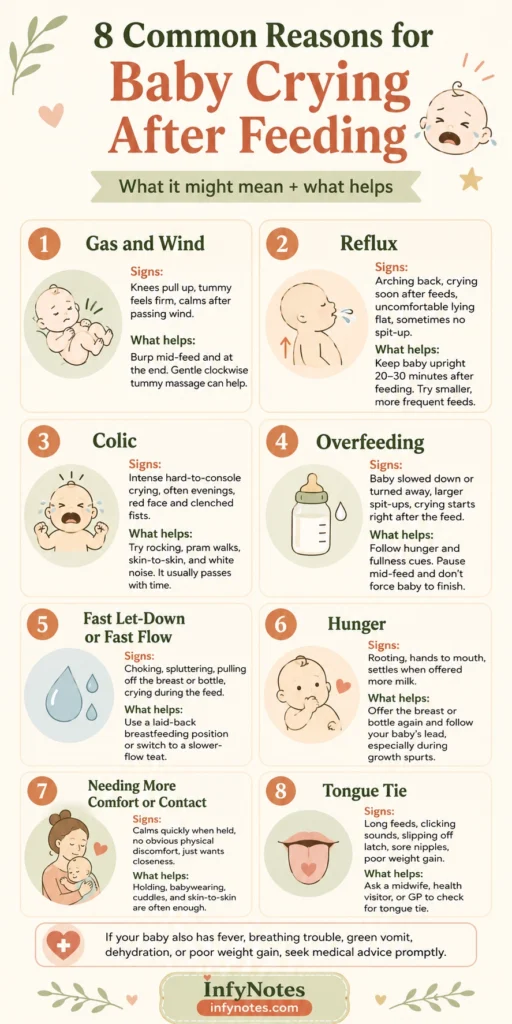
1. Gas and Wind
The most frequent cause of a baby crying after feeding, especially in the first few months. When babies feed — breast or bottle — they swallow air along with milk, which gets trapped and is genuinely uncomfortable until it moves.
Signs: baby pulls up their knees, tummy feels slightly firm, they calm briefly then cry again, or they settle after passing wind.
What helps: wind your baby mid-feed, not just at the end, especially if they’re a fast feeder or gulping. Gentle clockwise tummy massage after feeding helps move trapped gas along.
2. Reflux
Reflux happens when milk travels back up from the stomach into the food pipe — similar to adult heartburn. Most babies have some degree of it before 6 months, while the muscle at the top of the stomach is still developing.
Signs: baby arches their back during or after feeding, cries most intensely shortly after a feed, seems uncomfortable lying flat. Some babies have “silent reflux” with no visible spit-up at all.
What helps: keep baby upright for 20–30 minutes after feeding, offer smaller, more frequent feeds if bottle-feeding. Always lay your baby flat on their back to sleep — never on a prop or wedge.
3. Colic
Colic means a healthy, growing baby cries for more than three hours a day, three days a week, for more than three weeks. It typically starts around 2–3 weeks, peaks at 6 weeks, and usually resolves by 3–4 months. It’s not caused by feeding but often intensifies after feeds, which is why it gets confused with other causes.
Signs: intense, hard-to-console crying, often at the same time each day (usually evenings), red face, clenched fists — but completely fine between bouts.
What helps: rhythmic movement (rocking, pram walks), skin-to-skin, white noise. The hardest thing about colic is that it passes with time, not treatment.
4. Overfeeding
It’s possible to feed a baby more than their small tummy can comfortably hold — and baby crying after feeding can be a sign of too much, not too little.
Signs: baby slowed down or turned away during the feed but was encouraged to finish, frequent larger spit-ups, crying starts almost immediately after the feed ends.
What helps: follow your baby’s hunger and fullness cues rather than finishing every bottle. Pausing mid-feed to let them settle makes a real difference.

5. Fast Let-Down or Fast Flow
A forceful let-down (breastfeeding) or fast-flow teat (bottle feeding) sends milk faster than your baby can manage. They gulp to keep up, swallow air, and often take in more than they want.
Signs: baby chokes, splutters, or pulls off repeatedly during the feed; crying starts during rather than after.
What helps: try a laid-back breastfeeding position to use gravity to slow the flow. For bottle feeding, move down to a slower-flow teat.
6. Hunger (Yes, Even After Feeding)
Sometimes baby crying after feeding means they’re simply still hungry — especially common during growth spurts, which typically hit around 2–3 weeks, 6 weeks, 3 months, and 6 months.
Signs: baby roots, puts hands to mouth, or stops crying when offered more.
What helps: offer the breast or bottle again — a genuinely hungry baby will feed; a full one will turn away. Trust your baby’s lead over the clock. If you’re finding your feeding schedule isn’t quite fitting right now, our 3-month baby feeding schedule guide covers adjusting for growth spurts specifically.
7. Needing More Comfort or Contact
Some babies cry after feeding not because anything is physically wrong, but because the feed ending means less warmth, less closeness, less of you. That’s a need, not manipulation — and “spoiling” isn’t a real thing in the first year.
Signs: baby calms almost immediately when held skin-to-skin, no signs of physical discomfort, the crying has a rhythmic searching quality rather than an urgent distressed sound.
What helps: holding, babywearing, skin-to-skin. You’re not creating a bad habit — you’re meeting a developmental need. Our guide on what to do when your newborn won’t sleep unless held covers this overlap well.
8. Tongue Tie
A tongue tie means the strip of skin connecting the tongue to the floor of the mouth is shorter or tighter than normal, making it harder to latch effectively. Babies work harder to feed, swallow more air, and often take in less milk — leaving them uncomfortable and still hungry.
Signs: feeding takes a long time, clicking sound during feeds, repeatedly slipping off the latch, significant nipple soreness if breastfeeding, baby crying after feeding paired with poor weight gain.
What helps: ask your midwife, health visitor, or GP to check. A simple procedure called a frenulotomy can resolve it quickly — many parents describe it as a turning point. If bottle-feeding is also part of the picture, our post on when baby won’t take a bottle covers latch and flow issues that often run alongside tongue tie.
Research-Informed Tips to Reduce Baby Crying After Feeding
Burp more, and burp mid-feed. Most parents burp once at the end. Burping once in the middle and once at the end makes a significant difference for babies who are prone to gas discomfort after feeding.
Check your feeding position. Whether breast or bottle, the angle of feeding affects how much air your baby swallows. A more upright feeding position generally means less air intake than a flat or reclined one.
Pace your bottle feeds. Paced bottle feeding — holding the bottle more horizontally, letting the baby control the pace rather than the flow — significantly reduces the volume of air swallowed and is one of the most evidence-supported changes for bottle-fed babies who cry after feeds.
Don’t change too many things at once. It’s tempting when you have a crying baby to try everything simultaneously. But if you change formula, feeding position, teat flow, and burping technique at the same time, you’ll have no idea what helped. Change one thing, give it 2–3 days, then assess.
Keep a simple cry journal. Note the time of feed, how long it lasted, when the crying started, and what (if anything) helped. Patterns often emerge within a few days that give you — and your health visitor — much more to work with.
Mistakes to Avoid When Your Baby Cries After Feeding
Assuming it’s always hunger. Feeding a baby who’s uncomfortable from gas or overfeeding makes things worse. Check timing and other cues first.
Formula-switching without advice. The NHS advises changing formula rarely resolves crying unless there’s a specific diagnosed intolerance. Speak to your health visitor before switching.
Skipping the burp because baby seems fine. Some of the worst gas pain arrives 10–15 minutes after a feed. Always wind, even when they seem comfortable immediately after.
Googling symptoms at 3am. It almost always ends with a terrifying diagnosis. If you’re genuinely worried, call your health visitor in the morning, or in the UK, NHS 111 — they won’t think you’re overreacting.
Waiting too long to ask for help. If baby crying after feeding has been consistent for several days, or the crying is intense and inconsolable, bring it up with your health visitor or GP.

FAQ: Baby Crying After Feeding
You’re Doing Better Than You Think
A baby crying after feeding when you’ve just spent 20, 30, or 40 minutes getting that feed right is one of the most demoralising experiences of new parenthood. It can make you question everything — your supply, your technique, whether something is wrong, whether you’re somehow making it worse.
Most of the time, you’re not making anything worse. You’re just in the middle of the steep part of the learning curve, where your baby is still figuring out their digestive system and you’re still figuring out your baby. The fact that you’re here, reading and trying to understand, is exactly the right thing to be doing.
Pick one cause from this list that resonates most with what you’re seeing. Try one change. Give it a few days. And if nothing shifts and something still feels off, call your health visitor — that’s what they’re there for, and you’re not overreacting by asking.
Disclaimer
Some information in this article is based on my personal experience as a mother. Every mother and baby is different, so experiences and results may vary. Always consult a qualified healthcare professional regarding your health or your baby’s health.