

- What's Happening With Your Baby's Feeding at 3 Months?
- Baby Feeding Schedule 3 Months: How Often and How Much?
- Sample Baby Feeding Schedule 3 Months (24 Hours)
- 🌙 Night Feeds at 3 Months: What's Normal?
- Reading Hunger Cues vs. Other Cries
- Breastfeeding at 3 Months: Supply, Comfort & Returning to Work
- Feeding Mistakes to Avoid at 3 Months
- FAQs: Baby Feeding Schedule at 3 Months
- 💛 A Final Word From One Mum to Another
Baby feeding schedule 3 months can feel overwhelming to figure out — especially when everyone around you has a different opinion about what your baby needs.
I still remember those nights so clearly. My baby would cry, and before I could even pause to think why, someone in the house would say, “She’s hungry — feed her.” It didn’t matter that she had fed 20 minutes ago. It didn’t matter if she was cold, overtired, or simply needed comfort. Every cry seemed to have only one answer.
If you are here looking for help with a baby feeding schedule 3 months, you probably already know that exhausted, second-guessing, am I doing this right? feeling. Maybe you are feeding around the clock and wondering when — or whether — things will start to settle into a more predictable rhythm.
This post is here to help you build a realistic baby feeding schedule 3 months old babies can actually follow, while also making space for real life, real tiredness, and real mum emotions. Because you deserve both honest reassurance and practical guidance.
What’s Happening With Your Baby’s Feeding at 3 Months?
Three months in, most babies have moved past the truly unpredictable newborn phase. A more natural rhythm is starting to emerge — not a strict schedule yet, but definitely more pattern than chaos.
Here’s what’s changing at this age:
Bigger Stomach
Your baby can take more milk per feed, so longer stretches between feeds become possible.
Faster, More Efficient Feeds
Many 3-month-olds can drain a breast or bottle in 5–10 minutes. If feeds feel shorter, that’s normal — not a sign of low supply.
Longer Wake Windows
Babies this age are awake for about 1–1.5 hours at a time, which makes spacing feeds more predictable.
Growth Spurts
Around 12–13 weeks, many babies hit a growth spurt and want to feed constantly for a few days. If your schedule goes out the window briefly, that’s the reason. It passes.
Baby Feeding Schedule 3 Months: How Often and How Much?
Breastfed Babies
In the newborn weeks, breastfed babies typically feed 8–12 times per day. As babies grow, many begin to space their feeds naturally. By around 3 months, some babies settle into about 6–8 feeds in 24 hours, usually every 2.5–3.5 hours during the day, though patterns can vary from baby to baby. Growth spurts and cluster feeding can temporarily increase the number of feeds — that’s demand feeding working exactly as it should.
Guidance from KellyMom explains that frequent nursing in the early weeks is completely normal and helps establish a healthy milk supply. Many mothers worry that frequent feeding means something is wrong, but in most cases it simply reflects a baby responding to hunger cues and regulating milk production.
My experience:
In the early weeks I fed every two hours. By 3 months, my baby naturally started going longer between feeds — no schedule training, no forcing it. I stopped watching the clock and started watching her instead. The gaps just slowly widened on their own.
Around this same stage postpartum, many mums also start noticing something unexpected — hair shedding. It can feel alarming when strands suddenly appear in the shower or on your brush, but it’s actually a very common part of recovery after pregnancy. If you’re going through that too, understanding the postpartum hair loss timeline can be reassuring and help you know what’s normal.
Formula-Fed Babies
Formula-fed babies typically feed every 3–4 hours, around 5–6 times per day. Most 3-month-olds take 4–6 oz (120–180ml) per feed. The NHS guidance on bottle feeding recommends approximately 150ml per kilogram of your baby’s body weight per day as a general starting guide — but always confirm with your health visitor or paediatrician, especially if your baby is on the smaller or larger side.
Sample Baby Feeding Schedule 3 Months (24 Hours)
Think of this as a loose framework for your baby feeding schedule at 3 months, not a rigid timetable. Every baby is different — use it as a starting point and adjust to your baby’s cues.
| Time | Activity | Amount |
|---|---|---|
| 6:00–7:00 AM | Wake & Feed #1 | Breast: 10–15 min / Formula: 4–5 oz |
| 9:00–9:30 AM | Feed #2 | Breast: 10–15 min / Formula: 4–5 oz |
| 12:00 PM | Feed #3 (after nap) | Breast: 10–15 min / Formula: 5 oz |
| 3:00 PM | Feed #4 | Breast: 10–15 min / Formula: 5 oz |
| 6:00 PM | Feed #5 (bedtime routine) | Breast: 10–15 min / Formula: 5–6 oz |
| 9:00–10:00 PM | Dream feed — optional | Breast: 5–10 min / Formula: 3–4 oz |
| 2:00–4:00 AM | Night feed (if waking) | Breast: 10–15 min / Formula: 4 oz |
 Sleep & Feeding Tip
💡 About the Dream Feed
A dream feed means feeding your baby just before you go to bed, while they are still sleepy and not fully awake. For some babies, this can help stretch that first overnight sleep a little longer. For others, it may not change much. It is worth trying if nights feel hard — but do not stress if your baby does not respond to it.
🌙 Night Feeds at 3 Months: What’s Normal?
One of the biggest questions in any baby feeding schedule 3 months post is this: does a 3-month-old really still need night feeds?
Many do, yes. Some babies begin stretching to one 4–6 hour block at night. Others still wake every 2–3 hours. Both are completely within the normal range. In a typical baby feeding schedule 3 months old, night feeds are still very common, and most babies are not developmentally ready to drop them fully until somewhere between 4 and 6 months.
From my experience, I was feeding 2–3 times a night at 3 months. Tiring? Absolutely. But once I stopped fighting it and accepted that this was what my baby needed right now, the nights felt more manageable. This phase does not last forever — even when it feels like it will.
There is also the baby who does not cry — just lies there wide awake, kicking and smiling at 3am while you sit completely exhausted. This kind of day/night confusion can still happen at this age as your baby’s circadian rhythm is developing. Keep night feeds calm, dark, and boring — no talking, no eye contact, no playing — and maximise natural light and activity during the day. Most babies shift naturally between 3 and 4 months.
Some babies also struggle to settle unless they’re held, especially in the early months. If that sounds familiar, these gentle fixes for babies who won’t sleep unless held at night can help you start building better sleep habits.
If broken sleep is starting to affect your energy for feeding, it can help to understand the 4-month sleep regression so you can prepare rather than feel blindsided when sleep suddenly changes.
Reading Hunger Cues vs. Other Cries
This is one of the most important — and least talked about — parts of building a baby feeding schedule 3 months.
Early in my daughter’s life, everyone around me defaulted to feeding as the answer to every cry. And in the newborn days, that’s often right. But by 3 months, your baby cries for many reasons: tiredness, wind, overstimulation, cold, boredom, or simply wanting to be held.
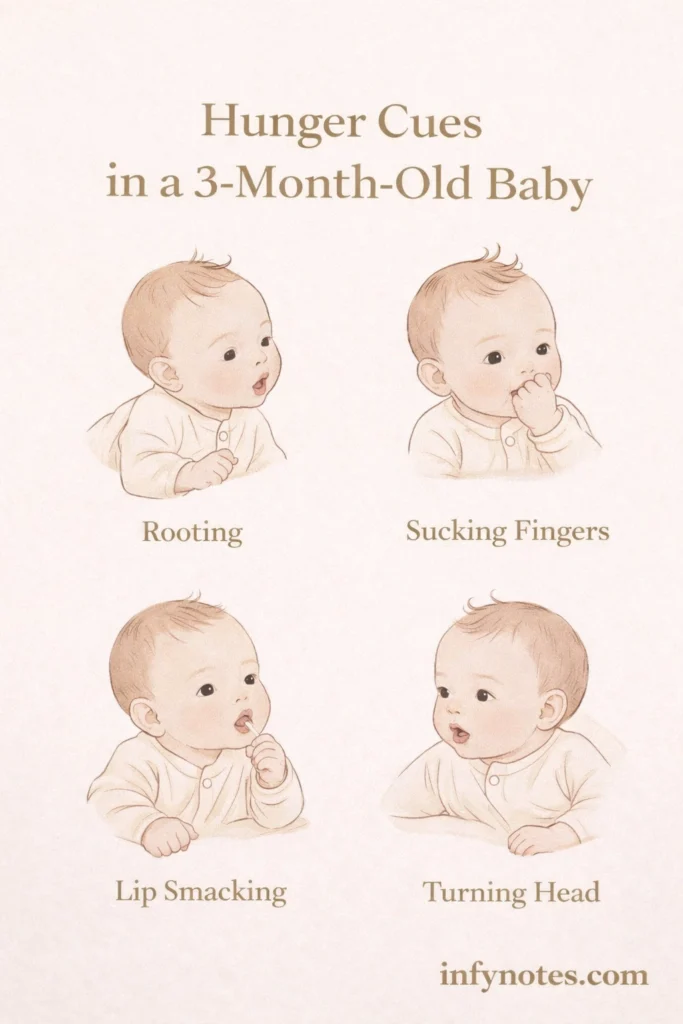
Hunger cues to look for:
- Rooting — turning head side to side, mouth opening
- Sucking fists or fingers
- Fussiness that increases gradually (not sudden screaming)
- Lip smacking or sticking out tongue
Signs it’s probably not hunger:
- Baby fed very recently and cries suddenly — may be wind or discomfort
- Baby is overtired (rubs eyes, yawns, arches back)
- Baby calms immediately when picked up and held — may need contact, not food
Learning your baby’s specific hunger cues is genuinely more useful than any schedule. Once you can tell a hunger cry from a tired cry, the whole day — and night — becomes easier to read.
Breastfeeding at 3 Months: Supply, Comfort & Returning to Work
Is My Supply Dropping?
Around 3 months, many breastfeeding mums notice their breasts stop feeling as full or engorged. This is not a sign of low supply — it’s supply regulation. Your body has worked out exactly how much milk your baby needs and is producing to that level. As long as your baby is gaining weight and producing enough wet nappies, you’re fine. Keep feeding on demand.
Feeding After a Difficult Birth
Nobody warns you that “sit up straight and feed” is impossible advice after an episiotomy or perineal tear. I had one, and upright night feeds were genuinely painful for weeks. I fed on the bed, on the floor — wherever I could manage. My legs would go numb. I sometimes needed help to stand afterwards, alone in the dark while everyone else slept.
If that’s you: a reclined position (propped up with pillows, not flat) or a side-lying feed can take pressure off your perineum completely. Feeding lying down during your recovery was not wrong — it was survival. Your healing matters.
Pumping and Returning to Work
If you’re heading back to work around the 3-month mark, maintaining your supply through pumping becomes important. A useful starting point: aim to pump every 3 hours during your work day to match your baby’s feed frequency. For a full guide on maintaining supply while returning to work, read How Often Should I Pump at Work? A Simple Schedule for Working Moms.
Feeding Mistakes to Avoid at 3 Months
Treating Every Cry as Hunger
Well-meaning family and a genuine desire to soothe your baby can lead to feeding as the first response to every cry. By 3 months, it’s worth pausing to check cues first — especially in formula-fed babies where overfeeding can cause discomfort.
Being Too Rigid With the Clock
A schedule is a guide, not a contract. Refusing to feed a clearly hungry baby because it’s “too early” can affect milk supply and cause unnecessary distress. Respond to real hunger cues and use the schedule as a reference — not a rulebook.
Comparing Your Baby’s Schedule to Others
Every baby’s feeding needs are different. Rather than comparing to other babies, track the signs that your baby is getting enough: 6+ wet nappies per day, steady weight gain, and a generally content baby between feeds.
Stopping a Feed Too Early
At 3 months, some babies are efficient feeders who pull away naturally after a few minutes. Others take longer. Don’t rush a feed to fit the clock — let your baby signal when they’re done.
FAQs: Baby Feeding Schedule at 3 Months
How many feeds does a 3-month-old need per day?
Most babies following a baby feeding schedule 3 months old will feed around 5–8 times in 24 hours. Breastfed babies tend toward the higher end, while formula-fed babies are often at the lower end. For detailed NHS guidance on amounts, see NHS bottle feeding advice.
How much formula should a 3-month-old have?
Typically 4–6 oz (120–180ml) per feed, 5–6 times per day. Total daily intake is usually around 25–32 oz. The AAP HealthyChildren formula feeding guide is an excellent reference for US and Canadian parents, and confirms that on-demand feeding is appropriate at this age.
Is it normal for a 3-month-old to feed every 2 hours?
Yes — in a baby feeding schedule 3 months old, feeding every 2 hours can be completely normal, especially for breastfed babies or during growth spurts. As long as your baby is gaining weight well and having enough wet nappies, this feeding pattern is usually nothing to worry about.
How do I know if my baby is getting enough milk?
Look for: 6+ wet nappies per day, steady weight gain at health visitor check-ins, and a baby who seems satisfied and calm between feeds. These are more reliable signs than measuring ounces.
Do 3-month-olds still need night feeds?
Many do, yes. Some babies begin stretching overnight sleep at this age, but night waking for feeds is still completely normal until 4–6 months. Try not to compare your baby to others who may seem to be sleeping longer.
My baby feeds more frequently some days — is that a growth spurt?
Very likely. Growth spurts around 12–13 weeks are common and usually last 3–5 days before settling back to the normal pattern. Feed on demand during this time.
💛 A Final Word From One Mum to Another
A baby feeding schedule 3 months is a framework — not a measure of how good a mother you are.
You might be feeding on a floor at 3am, legs numb, everyone else asleep, quietly keeping your baby fed and loved in the dark. That is not failure. That is one of the most devoted things a person can do.
Use this guide as a starting point. Trust your baby’s cues more than any clock. And give yourself the same patience and grace you’d give to any other mum doing the same thing.
When you’re ready for what comes next, this guide to the 4-month sleep regression will help you see it coming — and know you’re not alone.
Disclaimer: This article is based on personal experience and general guidance for parents. Every baby is different, and this post should not be used as a substitute for medical advice. Please speak to your paediatrician, GP, health visitor, or a qualified healthcare professional if you have any concerns about your baby’s feeding, growth, or wellbeing.