

- Why Won't My Newborn Sleep in the Bassinet?
- 10 Fixes to Try When Your Newborn Won't Sleep in Bassinet
- Expert Tips: What Sleep Consultants Actually Say
- Bassinet Products That Can Help
- Mistakes to Avoid When Your Newborn Won't Sleep in Bassinet
- FAQ: Newborn Won't Sleep in Bassinet — Real Questions Answered
- You're Going to Figure This Out, Mama
- Related Posts You'll Love
You bought the bassinet. You assembled it, positioned it perfectly next to your bed, added the fitted sheet, and felt prepared. And now your newborn won’t sleep in bassinet — not for five minutes, not for ten, not at all.
The moment you lower them in, the screaming starts. Or the eyes pop open. Or they sleep beautifully in your arms for forty minutes, and the second their back touches that mattress, it’s like you’ve placed them on hot coals.
You’re not imagining it. You’re not doing it wrong. And you are absolutely not alone.
If your newborn won’t sleep in bassinet, this guide is for you. We’re going to break down exactly why it happens, give you 10 practical fixes you can try tonight, and help you finally get some rest — safely, and without losing your mind. If your baby also refuses to sleep unless you’re holding them, you’ll want to read our post on Newborn Won’t Sleep Unless Held at Night? 9 Gentle Fixes That Work alongside this one.
Why Won’t My Newborn Sleep in the Bassinet?
Before you can fix the problem, it helps to understand what’s actually going on. Your newborn won’t sleep in bassinet for reasons that are completely biological and normal — even if they’re wildly inconvenient at 3 a.m.
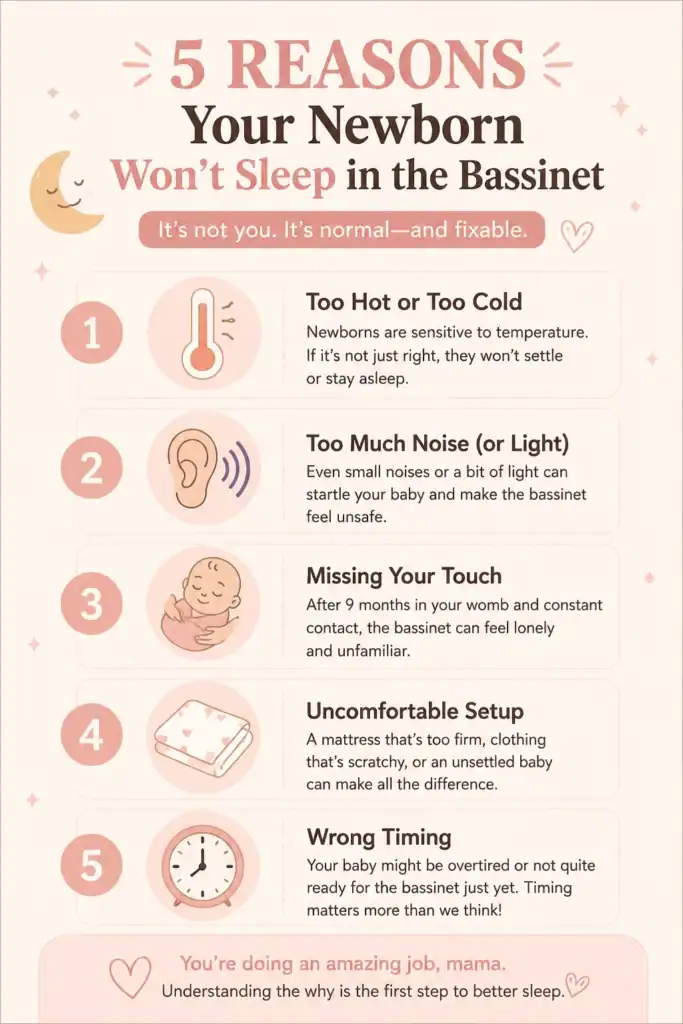
Here are the most common reasons:
1. The fourth trimester is real. For nine months, your baby lived in the warmest, tightest, most motion-filled environment imaginable. The bassinet — flat, still, cool, and open — feels nothing like the womb. It’s genuinely disorienting for a newborn.
2. The “transfer startle” (Moro reflex). When you lower a sleeping baby, the sudden loss of your body warmth and the shift in position triggers the Moro reflex — a full-body startle that jolts them awake every single time. This is completely normal and peaks in the first few months.
3. They associate sleep with you. Newborns are designed to want close contact. Being held regulates their breathing, temperature, and heart rate. The bassinet offers none of that — so your baby protests, because to their nervous system, being alone feels unsafe.
4. Discomfort or wind. A baby who is gassy, colicky, or feeding frequently may find lying flat uncomfortable. The pressure of a full tummy combined with a flat surface can cause real discomfort.
5. Temperature. Bassinets can feel cold compared to your chest. A mattress that hasn’t been warmed up is a shock to a tiny baby used to body heat.
Understanding these reasons helps you choose the right fix — because a newborn won’t sleep in bassinet for different reasons at different times.
According to the NHS safe sleep guidelines for newborns, the safest place for a newborn to sleep is on their back, on a firm flat surface — so while we work through these fixes, safe sleep always comes first.
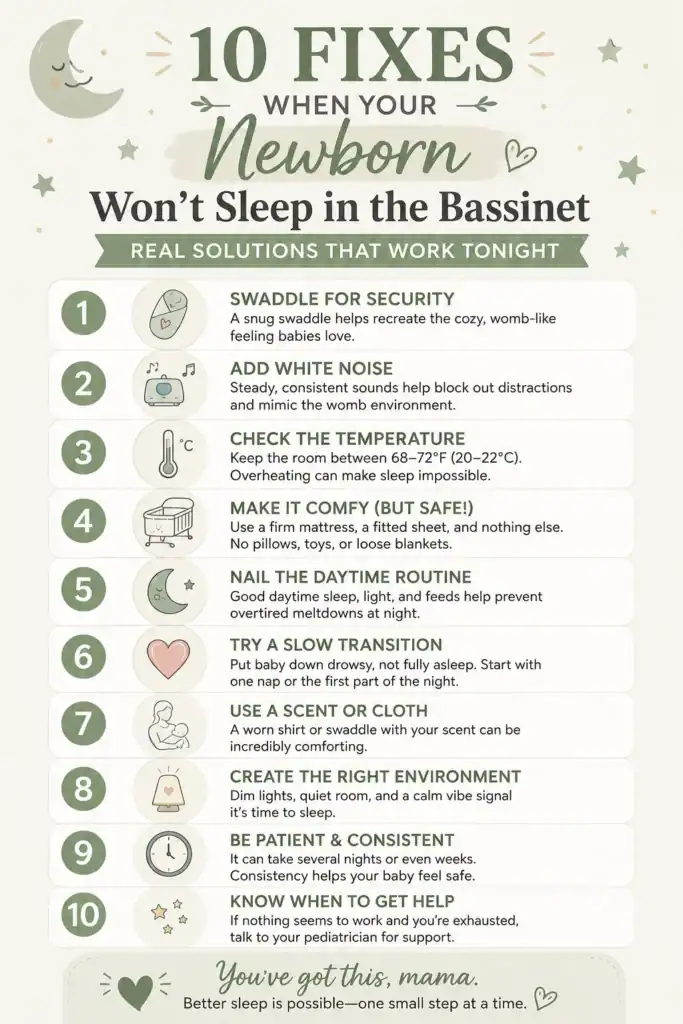
10 Fixes to Try When Your Newborn Won’t Sleep in Bassinet
These aren’t generic tips you’ve already seen everywhere. These are real, practical approaches that work for babies who genuinely resist the bassinet.
Fix 1: Make Sure Baby Is Comfortably Warm
Keep the room at a comfortable temperature and dress your baby appropriately for sleep. Avoid using hot water bottles, heating pads, or other heat sources in the bassinet. Check your baby’s chest or the back of their neck rather than their hands or feet to see if they feel too warm.
Fix 2: Perfect the Transfer Technique
Most parents lift their arms away too quickly. Instead: lower your baby slowly until their whole back and head are resting, then hold your position for 30–60 seconds before gently sliding your hands out from underneath. Keeping your face and warmth close during the transfer may make the transition feel gentler for your baby.
Fix 3: Swaddle Before the Transfer
Swaddling can help calm some newborns and may reduce waking from the startle reflex. If you swaddle, place your baby on their back for every sleep and make sure the swaddle is snug around the upper body while allowing the hips and legs to move freely. Stop swaddling as soon as your baby shows signs of trying to roll, and do not use weighted swaddles.
Fix 4: Keep the Bassinet Flat
If your baby seems uncomfortable when lying flat, especially after feeds, reflux, gas, or another source of discomfort may be contributing. Keep the bassinet mattress firm, flat, and non-inclined, and always place your baby on their back for sleep. Do not place towels, wedges, pillows, or other items under or on the mattress to create an incline. If reflux symptoms are frequent, severe, or affecting feeding or growth, speak with your pediatrician. For safe sleep, follow the AAP safe sleep guidance.
Fix 5: Use White Noise Carefully
White noise may help some babies settle by masking sudden household sounds. If you use a white noise machine, keep it as far from your baby as practical, use the lowest effective volume, and avoid placing it close to the bassinet. You can also use a timer or turn it off once your baby is asleep.
Fix 6: Use Your Presence During the Transfer
Hold your baby close before the transfer, lower them slowly, and keep a hand gently on their chest for a short moment after placing them down. Keep the bassinet itself clear, with only the fitted sheet.
Fix 7: Use a Bassinet Designed for Safe Sleep
Some babies settle more easily in a bassinet that includes gentle rocking or vibration. If you use one, make sure it is specifically designed and approved for infant sleep, with a firm, flat sleep surface. Follow the manufacturer’s instructions and stop using any motion feature if the product requires it for safe sleep. Do not use swings, rockers, or other inclined products as a substitute for a bassinet.
Fix 8: Don’t Wait Until They’re Fully Asleep
Some babies settle more easily when they are placed in the bassinet while drowsy but still slightly awake, rather than fully asleep. If they stir during the transfer, already being in the bassinet may make the transition feel less surprising.
This takes practice and patience, and it won’t work every time—especially in the early weeks.
Fix 9: Rule Out Hunger and Wind First
A baby who is hungry or has trapped wind may struggle to settle, whether they are in your arms or the bassinet. Make sure the feed is fully complete before any transfer. Wind your baby thoroughly — and if they seem uncomfortable lying flat, consider whether wind or mild reflux may be contributing.
According to La Leche League on newborn sleep and night waking, frequent night waking is biologically normal for breastfed newborns — so if your baby wakes every 1–2 hours regardless of where they sleep, that may reflect normal feeding needs rather than a problem with the bassinet itself.
Fix 10: Keep the Sleep Environment Simple
Keep the overall sleep environment calm and consistent: use a comfortable room temperature, dim lighting at night, and white noise at the lowest effective volume if it helps your baby settle. Keep the bassinet firm, flat, and clear with only a fitted sheet.
Expert Tips: What Sleep Consultants Actually Say
Certified paediatric sleep consultants consistently point to a few things that parents miss:
Timing is everything. Many babies miss their sleep window and become overtired, making it almost impossible to transfer them. Watch for early sleep cues — eye rubbing, yawning, slightly glazed eyes — and start the bedtime routine before they reach that peak.
Consistency matters more than perfection. As one certified infant sleep consultant puts it:
The bassinet location matters. The American Academy of Pediatrics safe sleep recommendations advise room-sharing (baby in the same room as parents) for at least the first 6 months. A bassinet placed very close to your side of the bed — so your baby can hear your breathing — settles many babies more effectively than one across the room.
Bassinet Products That Can Help
The right kit makes these fixes far easier to implement. These are the products sleep consultants and experienced parents consistently recommend when a newborn won’t sleep in bassinet:

🔊 White Noise Machine — Some babies find steady white noise soothing. Keep the machine as far from your baby as practical and use the lowest effective volume.
👶 Swaddle Blankets / Swaddle Wraps — Use a properly fitted swaddle that allows the hips and legs to move freely, and stop swaddling as soon as your baby shows signs of trying to roll. Do not use weighted swaddles.
🌙 Red-Spectrum Nightlight — A warm, dim nightlight can make nighttime feeds and checks less stimulating than bright room lighting.
🛏️ Rocking / Vibrating Bassinet — If you’re still choosing or are considering upgrading, a bassinet with built-in motion may be worth considering for babies who settle more easily with gentle motion. Choose only a bassinet designed and approved for infant sleep, and follow the manufacturer’s instructions
🌡️ Room Thermometer — The ideal room temperature for a sleeping newborn is 16–20°C (60–68°F). Knowing the exact temperature removes one variable from the puzzle.
📌 Save this post — pin it to your Newborn Sleep board so you have it handy for those desperate 3 a.m. moments.
Mistakes to Avoid When Your Newborn Won’t Sleep in Bassinet
Giving up too fast. Every baby adjusts differently, and improvement may be gradual. Trying something once and concluding it doesn’t work is the most common reason parents stay stuck.
Skipping the wind. Skipping the wind. A baby with trapped wind may struggle to settle when lying flat. Swaddling or white noise may not help if discomfort from trapped wind is contributing.
Making the bassinet too cosy. Bumpers, pillows, folded blankets, and soft inserts inside a bassinet are all unsafe. A firm, flat, empty surface is non-negotiable — comfort comes from the external environment (white noise, warmth, scent), not from soft items inside the sleep space.
Transferring too quickly. The most common transfer mistake. Hold your position for a full 60 seconds after your baby’s back touches the mattress. It feels like a long time when you’re bent over a bassinet, but it dramatically reduces the chance of a startle-wake.
Assuming it’s a bassinet problem when it’s a sleep association problem. If your newborn won’t sleep in bassinet but also won’t sleep in a pram, or anywhere else that isn’t your arms — that’s a contact/association pattern, not a bassinet problem specifically. Check out our guide on Newborn Won’t Sleep Unless Held at Night? 9 Gentle Fixes That Work for that specific scenario.
⚠️ Safety note: Always follow safe sleep guidelines. Your baby should always be placed on their back, on a firm flat surface, with no loose items in the sleep space. If you’re unsure whether your bassinet meets current safety standards, check the NHS safe sleep guidelines for newborns or the manufacturer’s guidance. Never use incline inserts, positioning wedges, or third-party accessories not approved for use with your specific bassinet.
FAQ: Newborn Won’t Sleep in Bassinet — Real Questions Answered
Q: Is it normal for a newborn to hate the bassinet?
Completely normal. A newborn who won’t sleep in bassinet is one of the most common concerns in the first few weeks. The bassinet feels nothing like where they’ve spent the last nine months — the adjustment takes time.
Q: How long does it take for a newborn to get used to the bassinet?
Every baby adjusts differently, and improvement may be gradual. If settling remains very difficult, or you’re concerned about feeding, reflux, breathing, growth, or your baby’s wellbeing, speak with your health visitor, GP, or pediatrician.
Q: Should I let my newborn cry in the bassinet?
For newborns, focus on responsive settling, feeding, and safe sleep rather than structured sleep training. If you’re considering sleep training later, speak with your pediatrician about what is appropriate for your baby.
Q: What if my newborn only sleeps in my arms?
This is very common and is about proximity and comfort rather than the bassinet specifically. The strategies in this post will help, but for more detail on this specific pattern, read our full guide on what to do when your newborn won’t sleep unless held.
Q: When does bassinet sleep usually improve?
Every baby adjusts differently, and improvement may be gradual. as the fourth trimester eases and babies become slightly more adaptable. The 4-month sleep regression can bring a new set of challenges — our Sleep Regression 4 Months: 9 Proven Fixes + 7 Signs guide covers exactly what to do when that hits.
Q: Is it safe to put anything in the bassinet to make it cosier?
No. The bassinet should always have a firm, flat, empty surface. No pillows, bumpers, positioners, or loose blankets. Comfort should come from outside the sleep space — white noise, room temperature, swaddling — never from items inside it.
Q: My newborn won’t sleep in bassinet during the day either — is that the same problem?
Daytime bassinet refusal and night-time refusal can have similar causes, but daytime naps can be harder for some newborns because the environment may be lighter, noisier, and more stimulating. The same fixes can help. For daytime naps, try a calm, darker environment and use white noise at a low volume if it helps your baby settle.
You’re Going to Figure This Out, Mama
A newborn who won’t sleep in bassinet is exhausting, demoralising, and — at 4 a.m. — it can feel completely hopeless. But it is fixable. Not always quickly, not always perfectly, but consistently, with the right approach.
Start with one or two fixes tonight — the white noise and the transfer technique are the two highest-impact changes most parents make.Start with one or two changes that feel practical and adjust based on how your baby responds.
Your newborn won’t sleep in bassinet right now — but they will. And you will sleep again.
You’ve got this. 💛
Found this helpful? Save it for tonight, and share it with a mum in the thick of it.
Disclaimer: Some information in this article is based on my personal experience as a mother. Every mother and baby is different, so experiences and results may vary. Always consult a qualified healthcare professional regarding your health or your baby’s health.