

- 10 Honest Truths About Going Back to Work After Baby UK
- Why Going Back to Work After Baby UK Feels So Overwhelming
- Your Legal Rights When Going Back to Work After Baby UK
- Your 30-Day Preparation Plan for Going Back to Work After Baby UK
- Childcare Options in the UK: A Quick Comparison
- Breastfeeding and Going Back to Work After Baby UK
- Real Stories From Mums Going Back to Work After Baby UK
- The Emotional Reality: Mum Guilt, Relief, and Everything In Between
- Rebuilding Work Confidence After Maternity Leave
- Mistakes to Avoid When Going Back to Work After Baby UK
- FAQ: Going Back to Work After Baby UK
- You Are More Ready Than You Think — Going Back to Work After Baby UK
It’s 10:42pm. The baby is finally asleep. Your work outfit is laid out. Your bag is packed. And you’re sitting on the edge of your bed, staring at the wall, thinking: “Am I really ready for this?”
Going back to work after baby UK is not just returning to your job. It’s returning as a completely different version of yourself — carrying love, exhaustion, ambition, responsibility, and guilt all at the same time, in the same body that hasn’t slept properly in months. (And if you’re also dealing with postpartum hair loss on top of everything else, you are very much not alone in that either.)
If you feel anxious, conflicted, terrified, or secretly a tiny bit excited and then immediately guilty about that — you are completely, utterly normal. This guide won’t fob you off with platitudes. Instead, it gives you legal rights, a practical 30-day plan, real stories, childcare comparisons, breastfeeding guidance, and the emotional toolkit you need when going back to work after baby UK — so you come back not just surviving, but actually okay.
10 Honest Truths About Going Back to Work After Baby UK
The guilt is real — and so is the relief.
You have more legal rights than you think.
The first week is the hardest — it gets easier.
Your baby will be okay.
Childcare guilt fades faster than you expect.
You are allowed to enjoy being back.
Flexible working is now a day-one right.
Breastfeeding at work is completely possible.
Imposter syndrome is normal and temporary.
Give yourself six weeks before judging anything.
Why Going Back to Work After Baby UK Feels So Overwhelming
Returning to work after maternity leave doesn’t feel hard because you’re weak. It feels hard because it is genuinely multiple pressures arriving simultaneously. Separation anxiety that hits you harder than it hits your baby. Hormonal shifts that can linger well into the first year. Accumulated sleep deprivation that makes every decision feel harder than it is — and if your baby is still refusing to sleep independently at night, you already know what sustained exhaustion does to a human brain.
Add financial pressure — Statutory Maternity Pay drops significantly after six weeks, meaning many mums return before they’re emotionally ready. And underneath it all, an identity shift: the person who left for maternity leave and the person walking back in are simply not the same.
In the UK, most mums return between 9 and 12 months. In the US, many are back at 6–12 weeks. In Canada, parental leave can stretch to 18 months. The timeline differs everywhere. The emotional weight is universal. There is no perfect time to return — only the time that works for your family.
Your Legal Rights When Going Back to Work After Baby UK
Understanding your rights removes fear faster than almost anything else. Here is what UK law actually guarantees you.

Statutory Maternity Leave
You’re entitled to up to 52 weeks total: 26 weeks of Ordinary Maternity Leave (OML) followed by 26 weeks of Additional Maternity Leave (AML). You must take a minimum of two weeks after birth, or four weeks if you work in a factory or similar environment.
Right to Return to Your Job
If you return within 26 weeks, you have the legal right to go back to exactly the same role on the same terms. After 26 weeks, you have the right to the same job or a suitable alternative on no less favourable terms. If your employer significantly changes your role or makes you redundant during maternity leave, that may be unlawful — contact ACAS immediately for free, confidential guidance.
Flexible Working Rights — April 2024 Update
From April 2024, you can request flexible working from day one of employment — no more waiting 26 weeks. This covers reduced hours, compressed hours, hybrid working, remote working, or different start and finish times. Employers must respond within two months and must provide a legitimate business reason to decline.
KIT Days — Keeping In Touch
You can use up to 10 paid Keeping In Touch days during maternity leave. They’re voluntary, don’t affect your leave or pay, and are ideal for easing back gradually — attending a team meeting, touching base with your manager, or simply reminding yourself that you still know what you’re doing.
- Reach out to HR or your manager at least 8 weeks before your return date.
- Confirm your start date in writing. Ask about any team, role, or process changes while you were away.
- Raise flexible working at this meeting — early conversations land better than last-minute ones.
Your 30-Day Preparation Plan for Going Back to Work After Baby UK
The biggest mistake mums make when going back to work after baby UK is leaving all logistics until the week before. Spreading the load over four weeks makes it manageable rather than a cliff edge.
Week 1: Lock Down Childcare
- Confirm nursery, childminder, or nanny contract in writing
- Register for Tax-Free Childcare — the government tops up your childcare account by 25%, up to £2,000 per child per year
- Look into the 15 or 30 free childcare hours entitlement (age and household dependent)
- Check Universal Credit childcare element if applicable
Week 2: Test the New Normal
- Do settling-in sessions at nursery or with your childminder — they’re hard but they protect your first real week enormously
- Run a full trial morning: wake-up, feed, get everyone ready, do the drop-off, time the commute
- Identify the bottlenecks (hint: it’s getting yourself ready, not the baby)
- Write a childcare bag checklist and stick it on the fridge the night before
Week 3: Pumping Preparation (If You’re Breastfeeding)
- Speak to HR about your legal entitlement to a private pumping space and milk storage
- Build a pumping schedule that mirrors your baby’s feed times
- Start practising your pump routine at home two to three weeks before you return
- Begin building a small freezer stash — enough for peace of mind, not a warehouse supply
A hands-free breast pump is one of the best investments you can make before going back to work. The Elvie Stride and Medela Freestyle Flex both fit discreetly inside your bra so you can pump during a Teams call or lunch break.
Pair it with an insulated milk storage bag and reusable milk pouches for easy transport. Search current UK prices on Amazon — deals appear regularly.
Week 4: Work and Mind Reset
- Read back through key emails and project updates to reduce first-day shock
- Write a short list of your core responsibilities — it actively counteracts imposter syndrome
- Plan a week of simple evening meals: slow cooker, batch cook, or a meal kit service
- Have an honest conversation with your partner about the mental load — who covers what, and when
- Lower your domestic standards now, before you need to, not after
Childcare Options in the UK: A Quick Comparison

One of the most stressful parts of going back to work after baby UK is choosing the right childcare. There is no universally best option — the right choice depends on your hours, budget, location, and your child’s personality. Many families combine options: nursery three days, grandparent two days. Use this table as a starting point, not a verdict.
| Option | Avg. Cost | Flexibility | Pros | Cons |
|---|---|---|---|---|
| Nursery | £50–£90/day | Fixed | Socialisation, structured routine | Less personal flexibility |
| Childminder | £35–£60/day | Moderate | Home setting, smaller groups | Limited availability |
| Nanny | £12–£18/hr | Very high | One-to-one, tailored care | Most expensive option |
| Family/Grandparent | Free–£ | High | Trusted, familiar faces | Can blur boundaries |
Breastfeeding and Going Back to Work After Baby UK
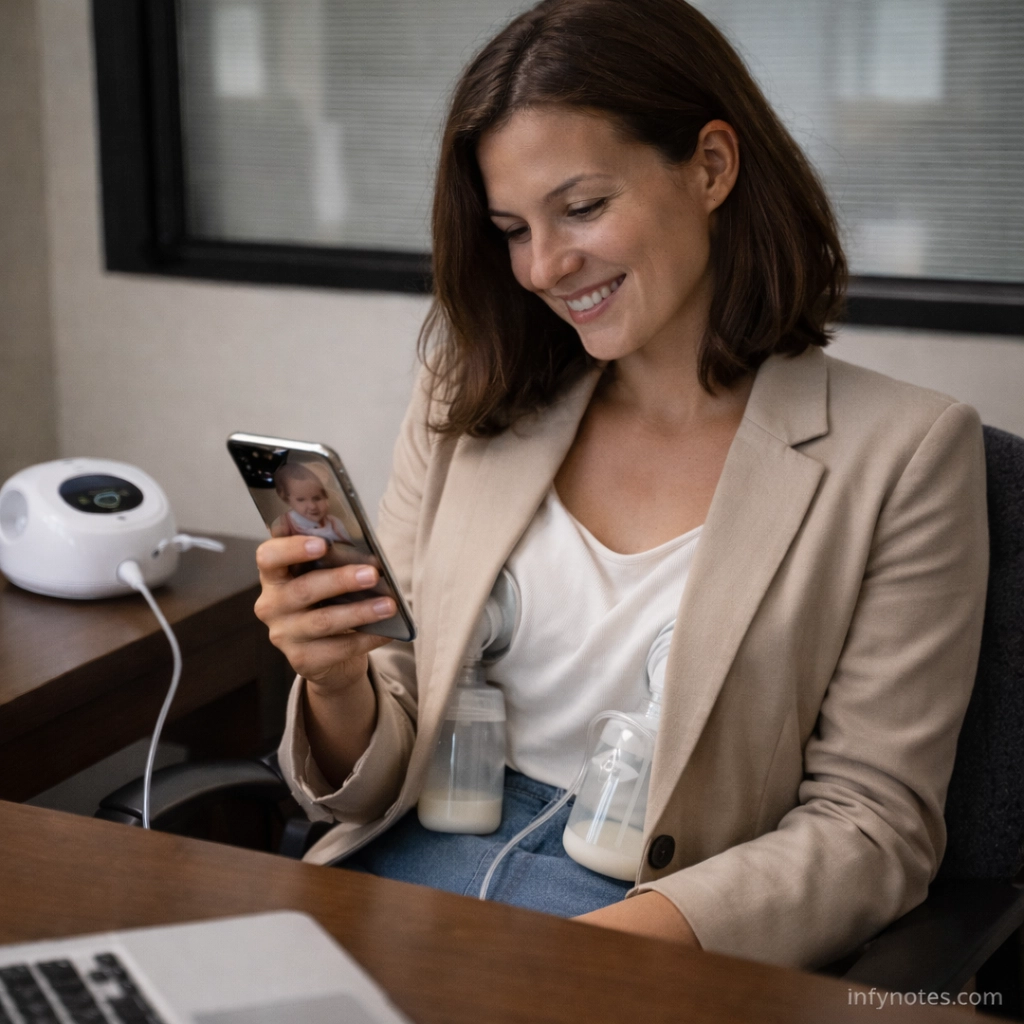
If you’re still breastfeeding when you return, you are not obliged to stop. By law, your employer must provide a private space (not a toilet cubicle), reasonable breaks to pump, and somewhere hygienic to store expressed milk. If your employer pushes back, escalate to HR and, if necessary, to ACAS.
If you’re working out exactly how to structure your pumping sessions around meetings and your workday, our guide on how often you should pump at work gives you a full, practical schedule based on your baby’s age and your supply goals — it pairs perfectly with this post.
Practically speaking: aim to pump at the times your baby usually feeds. Your supply adapts quickly once you establish a consistent schedule. Many mums naturally move to morning and evening feeds only once back at work, dropping daytime pumping within a few weeks — that transition is completely normal and the body handles it well.
Real Stories From Mums Going Back to Work After Baby UK
You can read all the advice in the world. But sometimes what you need most is to know that someone else has sat exactly where you’re sitting right now — and survived it.
The Mum Who Cried Every Morning
I once worked with a colleague who had a one-year-old baby. Every morning before she started work, she opened her phone and stared at her baby’s face — her wallpaper. She told me: “I just want to be with her. I want to play with her. I don’t want her to feel alone.”
She couldn’t quit. Her family depended on her income. Some mornings she and her husband dropped the baby together. The baby cried. She cried. Then she came to work and tried to function normally. She felt like she had only two choices: quit and struggle financially, or go to work with a stone heart and build something for her daughter’s future. Neither choice felt peaceful.
During meetings, she couldn’t always focus. Her baby’s face was always somewhere in her mind. That wasn’t weakness. That wasn’t distraction. That was motherhood.
The Mum Who Worked From Home — But Still Felt Divided
My cousin returned to work after six months of maternity leave. She works from home. From the outside it looked ideal — no commute, baby just upstairs. But reality was something else entirely.
When she was in meetings, her baby would stretch out tiny hands wanting to be held. Sometimes the baby cried while she was listening to her manager speak. She was physically present at work and physically present at home — but fully present in neither. She once told me quietly: “I’m here… but I’m not really here.”
Her baby is now 18 months old. She still carries the financial pressure. She still shows up every day. And she is, slowly, finding her rhythm.
Different Countries. The Same Mother Love.
These two women live in different countries, with different financial pressures and different work setups. But they share one thing entirely: the love. The guilt. The longing. The quiet, daily act of choosing to keep going anyway.
Whether you go back to work after six months in India, nine months in the UK, or twelve weeks in the United States — the emotional pull is identical. Going back to work does not reduce mother love. It stretches it. It proves it.
If reading those stories brought a lump to your throat — that’s the point. That feeling is the invisible thread connecting every working mum who is going back to work after baby UK and everywhere else. You are not alone. Now let’s talk about how to actually get through it.
The Emotional Reality: Mum Guilt, Relief, and Everything In Between
On the night before you return, you might feel like you’re abandoning your baby. Like other mums are doing it differently and better. Like you should feel more grateful to have a job. And underneath all of that, there might be a small, guilty flicker of excitement — and then you feel terrible about the excitement. All of it is normal when you are going back to work after baby UK. Every contradictory feeling. Holding your career and your love for your child in the same hands at the same time is genuinely hard. It doesn’t resolve neatly. It coexists.
“I cried every single morning for two weeks. Then one day I realised I’d had three cups of tea while they were still hot, finished a thought without interruption, and felt like myself for the first time in months. It doesn’t mean I love him any less. It means I’m a whole person too.”
Research consistently shows that quality childcare does not damage secure attachment. Secure attachment comes from responsiveness and connection — not from 24-hour physical presence. The NHS postnatal mental health guidance is a reassuring, evidence-based read on this. Your child is not harmed by being cared for by someone else. They are learning that the world is safe and that you always come back.
Emotional shock. This is the hardest stretch. Everything feels wrong.
Routine begins to form. The mornings get slightly less chaotic.
New normal. Most mums report feeling more like themselves than they have in months.
Rebuilding Work Confidence After Maternity Leave

Almost every mum experiences imposter syndrome when she returns. You might feel slower, less sharp, less certain — like everyone else in the room knows something you’ve forgotten. This is adjustment, not incompetence. The skills are still there. They just need dusting off.
Maternity leave does not make you less capable. It makes you different. You’ve built patience, crisis management, creative problem-solving, and the ability to function under sustained pressure that your colleagues frankly cannot match. The person walking back in is not lesser. She is more.
- Take on manageable tasks first — build momentum before you tackle the big stuff
- Clarify your priorities with your manager in week one rather than guessing
- Don’t volunteer for everything immediately — give yourself permission to ease in
- Protect your lunch break for the first month. Eat away from your desk. Breathe.
- Leave on time without apologising. You have somewhere to be.
- Find your people — other parents in the office, a working mum WhatsApp group, a parents’ network at work
Mistakes to Avoid When Going Back to Work After Baby UK
- Trying to perform at pre-baby levels in week one. You are in transition, not a performance review.
- Overbooking evenings. Protect at least two evenings a week as home evenings with no outside commitments.
- Skipping settling-in sessions to save annual leave. Those sessions protect your first week back enormously.
- Not submitting a flexible working request because you assume they’ll say no. Ask. The worst outcome is a formal decline — and you’ll know exactly where you stand.
- Ignoring persistent anxiety. If the dread doesn’t ease by week 6–8, speak to your GP. Postnatal anxiety is common at this transition point and entirely treatable.
- Maintaining pre-baby domestic standards. Lower the bar now. Batch cook, accept the mess, use the slow cooker.
FAQ: Going Back to Work After Baby UK
1. When do most UK mums go back to work after baby UK?
Most mums who are planning going back to work after baby UK return between 9 and 12 months, with many taking the full 52-week entitlement. Some go back earlier for financial reasons, especially because Statutory Maternity Pay drops after the first six weeks. There is no right or wrong timeline. The best return date is the one that works for your family’s finances, childcare situation, and emotional readiness.
2. Can I change my working hours when going back to work after baby?
Yes. Under the April 2024 update, you can request flexible working from day one of employment. This covers reduced hours, compressed hours, hybrid working, remote working, or changed start and finish times. Your employer must respond within two months and must give a legitimate business reason to decline. Raising this at your return-to-work meeting gives you the best chance of a positive outcome.
3. What childcare financial help can I get in the UK?
Tax-Free Childcare offers a 25% government top-up on costs, up to £2,000 per child per year (£4,000 for disabled children). The free hours entitlement covers 15 or 30 hours per week for eligible children, now extending to younger ages from September 2024. Universal Credit includes a childcare element for lower incomes. Check full eligibility at gov.uk as rules vary by circumstance.
4. Is it normal to feel like you’ve made the wrong decision after going back?
Very normal, particularly in the first four weeks. The feeling of regret or doubt during this period almost always reflects the difficulty of adjustment — not the reality of the decision. Apply the 6-week rule: do not judge your decision until you’re six weeks in and the routine has had a chance to form. If the doubt persists beyond that, have an honest conversation with your partner about your options.
5. How long does it take to adjust to going back to work after maternity leave?
For most mums, the acute adjustment period is 4–8 weeks. The first week is almost always the hardest. By weeks three and four, a rhythm usually begins to form. By week six to eight, many mums report feeling more like themselves than they have in months — including genuinely enjoying parts of their working day. If things haven’t eased by week eight, please speak to your GP.
6. Can I keep breastfeeding when I go back to work full time?
Absolutely. Your employer must provide a private, hygienic space (not a toilet) and reasonable breaks to express milk. Many mums successfully combine full-time work and breastfeeding with a hands-free pump and a consistent schedule. You do not need to wean before returning. Most mums naturally transition to morning and evening feeds only within the first few weeks back, and the body adapts well.
You Are More Ready Than You Think — Going Back to Work After Baby UK
Going back to work after baby UK is not about choosing your career over your child. It is about building a life where both exist — your baby and your whole, full, capable self.
You will probably cry at the first drop-off. You will probably question yourself around 3pm on a Tuesday when your baby does something new that you weren’t there to see. You will also, sooner than you expect, remember what it feels like to finish a task, have an uninterrupted thought, and rediscover parts of yourself that maternity leave gently reshaped.
The two women in the stories above kept going — not because it was easy, but because their love for their children is precisely what gave them the strength to do hard things. That is you too.
Give yourself the first six weeks. Lean on your people. Ask for what you need at work. Lower every standard that doesn’t matter. And when the guilt whispers that you’re not enough, remind it that your child doesn’t need a perfect mother. They need a happy, whole, supported one.
You’ve got this. One morning at a time.
Disclaimer: This post is for general informational purposes only and is not intended as legal, medical, or financial advice. Information may change over time and may not apply to every situation. For advice specific to your circumstances, please consult a qualified professional.