
- What Is a Baby Teething Timeline, Really?
- Why the Baby Teething Timeline Varies So Much From Baby to Baby
- Recognizing the Real Signs of Teething
- Practical Solutions That Actually Help
- Expert Tips for Surviving Each Stage of the Baby Teething Timeline
- Mistakes to Avoid on the Baby Teething Timeline Journey
- Frequently Asked Questions About the Baby Teething Timeline
- Final Thoughts: Trust Your Baby's Own Timeline
It’s 2 a.m. Your baby is chewing on your shoulder like it personally wronged them, drooling through their third onesie of the night, and screaming in a way you’ve never heard before. You’re standing in the dark googling “baby teething timeline” on your phone, desperate for one simple answer: is this normal, and when does it end?
If that’s you right now — take a breath. You are not doing anything wrong, and your baby is not “difficult.” Teething is one of the most predictable, universal, and misunderstood parts of infancy, and once you understand the real baby teething timeline, the guesswork (and a lot of the panic) disappears.
This guide walks you through exactly when teeth come in, what’s actually normal, what’s not, and how to survive the process with your sanity — and your shoulder — intact.
What Is a Baby Teething Timeline, Really?
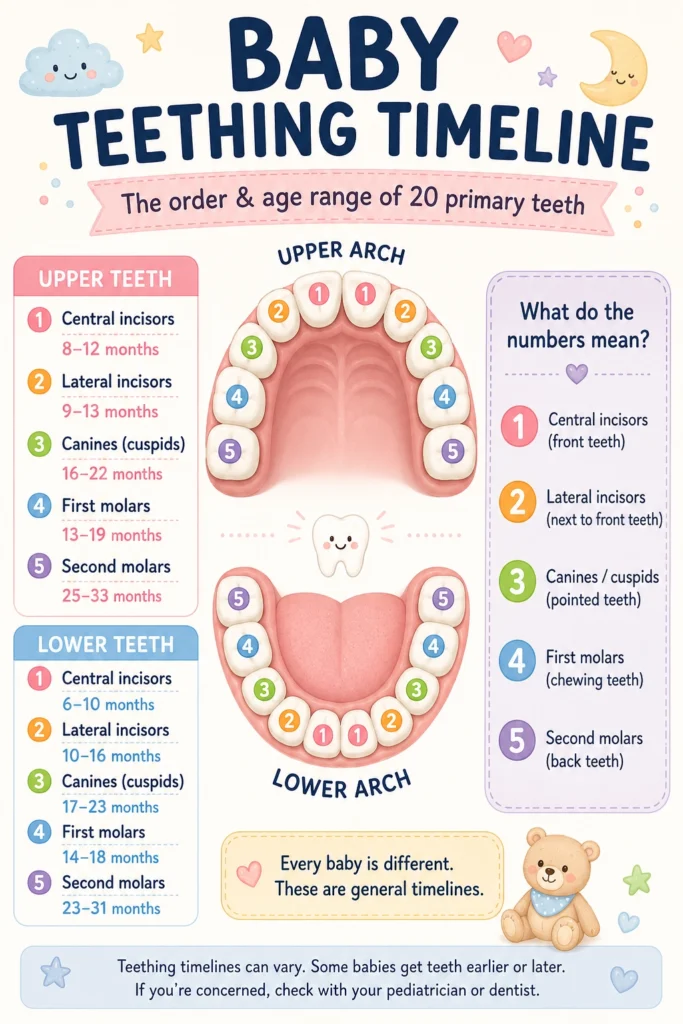
A baby teething timeline is simply the general order and age range in which your baby’s 20 primary (baby) teeth are expected to erupt, from the first bottom incisor to the final second molar. Doctors use this timeline as a guide, not a rulebook, because every baby’s mouth works on its own clock.
Here’s the general baby teething timeline most pediatric dentists reference:
- 6–10 months: Bottom two front teeth (central incisors)
- 8–12 months: Top two front teeth (central incisors)
- 9–13 months: Upper lateral incisors (either side of the front teeth)
- 10–16 months: Lower lateral incisors
- 13–19 months: First molars (back teeth used for chewing)
- 16–22 months: Canines (the pointy “eye teeth”)
- 23–33 months: Second molars
By age 3, most children have all 20 baby teeth. The American Academy of Pediatrics confirms this general order, but stresses it’s an average, not a deadline. Some babies get their first tooth at 4 months. Some don’t get one until 14 months, and that’s still considered completely normal as long as your pediatrician isn’t seeing other developmental concerns.
Why the Baby Teething Timeline Varies So Much From Baby to Baby
Genetics play a huge role — if you or your partner teethed early or late, your baby likely will too. Premature babies often teethe later based on their adjusted age rather than their birth date. And some babies simply have a naturally later eruption schedule with zero underlying issue at all.
This is the part I wish someone had told me sooner: comparing your baby’s teething timeline to another baby’s timeline is one of the fastest ways to stress yourself out over nothing.
Recognizing the Real Signs of Teething
Before you can match your baby to a teething timeline, you need to know what you’re actually looking for. Common signs include:
- Excessive drooling (soaked collars, constant wiping)
- Chewing or gnawing on everything within reach
- Swollen, tender, or reddened gums
- Mild irritability or fussiness, especially in the evening
- Slightly disrupted sleep
- A mild rise in temperature (not a true fever)
- Rubbing ears or cheeks (referred gum pain)
- Reduced appetite for a few days
What teething does not typically cause: high fever, diarrhea, vomiting, or a full-blown rash. According to the NHS guidance on teething, these symptoms point to something other than teeth coming through, so it’s worth a call to your pediatrician rather than blaming it on teething — a stomach bug or ear infection can easily masquerade as “just teething.”
Interestingly, teething discomfort often shows up before a tooth is even visible, which is why so many parents feel like the baby teething timeline “doesn’t match” what they’re seeing — the pain phase can start weeks before the tooth actually breaks through.
Practical Solutions That Actually Help
Once you know where your baby sits on the baby teething timeline, here’s what genuinely helps in the moment:

1. Cold Pressure on the Gums
A clean, chilled (not frozen solid) teething ring or a cold, damp washcloth pressed gently on the gums works wonders. The cold numbs the area slightly while the pressure satisfies the urge to bite.
2. Gentle Gum Massage
Wash your hands, and use a clean finger to rub your baby’s gums in small circles. Many babies find this instantly soothing, especially during a rough patch like the molar stage.
3. Safe Teething Toys
Silicone or natural rubber teething toys designed for baby’s age and stage give them something safe to gnaw on. Avoid anything with small parts, liquid-filled cores that could leak, or amber teething necklaces, which pose choking and strangulation risks and aren’t recommended by pediatric associations.
4. Cold (Not Frozen) Foods for Older Babies
If your baby has started solids, chilled (not icy) mashed fruit, yogurt, or a mesh feeder with cold fruit can offer relief along with a nutritional boost — this is also a great window to revisit yourbaby feeding schedule if mealtimes have gotten chaotic during a teething flare-up.
5. Extra Comfort and Skin-to-Skin
Sometimes the biggest relief isn’t a product at all — it’s just more holding, more closeness, and more patience. Teething is uncomfortable and a little scary for a baby who doesn’t understand what’s happening in their own mouth.
Expert Tips for Surviving Each Stage of the Baby Teething Timeline

- Track patterns, not just symptoms. Keep a simple note of fussy days, drool spikes, and sleep changes. Over a few months you’ll start recognizing your baby’s personal teething timeline and can prep in advance.
- Expect sleep disruption around each new tooth. Teething discomfort is a very common (and very temporary) cause of disrupted nights — if you’re also dealing with a bigger sleep shift, our guide on the 4-month sleep regression breaks down how to tell the two apart.
- Molars hit hardest. The first and second molars (usually 13–33 months) tend to cause the most discomfort because of their size and location. Be extra patient during this stretch.
- Night wakings spike around new teeth. If your baby who normally settles fine is suddenly waking often and wants to be held, it may be teething rather than a habit — this is a good moment to revisit gentle approaches like those in our piece on a newborn who won’t sleep unless held, since the same soothing techniques often apply.
- Talk to your dentist by age 1. Even if your baby’s teething timeline is delayed, most pediatric dental associations recommend a first dental visit around the first birthday or within six months of the first tooth.
Mistakes to Avoid on the Baby Teething Timeline Journey
- Reaching for teething gels with benzocaine. The FDA has warned against benzocaine teething products, linking them to a rare but serious condition affecting oxygen in the blood, and recommends against them for children under 2 without medical guidance.
- Giving frozen (rock-hard) teethers. Frozen items can bruise soft gums. Chilled is enough — skip the deep freeze.
- Blaming every fever or diarrhea on teething. This is the single biggest mistake parents make during this stretch — it delays real diagnoses.
- Comparing timelines between babies. Your niece’s baby had 4 teeth by 6 months; your baby has none. Both can be completely normal.
- Ignoring your gut feeling. If something feels “off” beyond typical teething fussiness, trust yourself and call your pediatrician.
- Using amber necklaces or bracelets. They carry choking and strangulation risk and have no proven pain-relief benefit backed by pediatric health bodies.

Frequently Asked Questions About the Baby Teething Timeline
Disclaimer
Some information in this article is based on my personal experience as a mother. Every mother and baby is different, so experiences and results may vary. Always consult a qualified healthcare professional regarding your health or your baby’s health.
Final Thoughts: Trust Your Baby’s Own Timeline
If you take one thing away from this baby teething timeline guide, let it be this: the chart is a map, not a schedule your baby has to follow. Some babies cruise through teething with barely a whimper. Others announce every single tooth with an Oscar-worthy performance. Both are normal.
You’re doing a good job. Keep the cold teethers stocked, keep your patience close, and trust that — sooner or later — those little teeth will make their appearance right on your baby’s own perfectly normal timeline.
“Your baby is not behind. They are simply growing in their own beautiful time.”