
- What Is Gentle Sleep Training?
- When Can You Start Gentle Sleep Training?
- 7 Gentle Sleep Training Methods (Explained Simply)
- Expert Tips to Make Gentle Sleep Training Work Faster
- Mistakes to Avoid with Gentle Sleep Training
- Sleep Products That Support Gentle Sleep Training
- FAQ: Gentle Sleep Training Questions Moms Actually Ask
- You're a Good Mum — Even on the Hard Nights
It’s 2 a.m. You’ve fed, rocked, shushed, and bounced. The moment you lower your baby into the cot — those eyes pop open. Again.
If this is your life right now, you’re not alone, and you’re not doing anything wrong. But you are exhausted. And you deserve sleep too.
That’s where gentle sleep training comes in. Not the leave-them-to-cry approach that makes your stomach turn. Not a rigid schedule that ignores your baby’s needs. But a real, compassionate, evidence-based way to help your little one learn to sleep — with you right there, every step of the way.
In this guide, you’ll learn exactly what gentle sleep training is, which methods work best, common mistakes to avoid, and how to finally get more sleep without the guilt. If you’re also dealing with the dreaded 4-month regression, don’t miss our post on Sleep Regression 4 Months: 9 Proven Fixes + 7 Signs — it goes hand-in-hand with everything we cover here.
Let’s get into it.
What Is Gentle Sleep Training?
Gentle sleep training is an approach to teaching your baby healthy sleep habits while remaining emotionally responsive to their needs. Unlike traditional “cry it out” (CIO) methods, gentle sleep training focuses on gradual change, parental presence, and respect for your baby’s developmental stage.
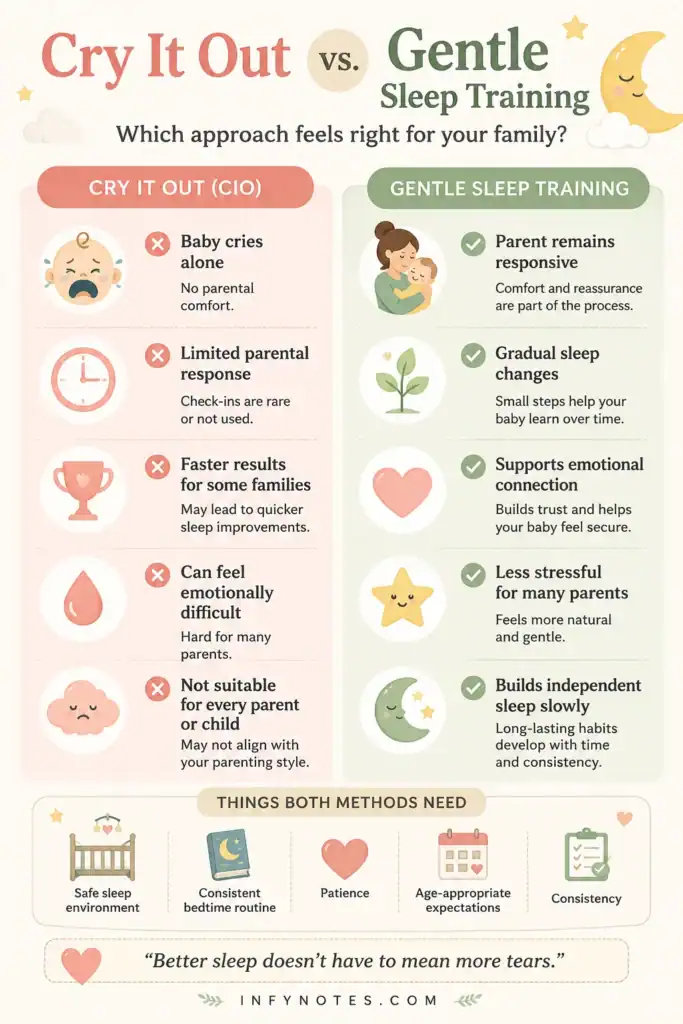
The goal isn’t to eliminate all night wakings overnight (that’s unrealistic for young babies). The goal is to reduce sleep associations that require your physical presence — like needing to be held, fed, or rocked to sleep every single time — and gently guide your baby toward more independent sleep.
According to the NHS guidance on helping your baby sleep, babies begin developing more predictable sleep patterns from around 3 months, though every child is different. Gentle sleep training works with that natural development rather than forcing it.
Key principles of gentle sleep training:
- Respond to your baby — don’t ignore cries
- Make changes gradually
- Stay consistent (but give it time)
- Respect your baby’s age and temperament
- Prioritise the emotional connection
As one certified paediatric sleep consultant puts it:
“The goal of gentle sleep training is not to stop all crying, but to support babies while they learn new sleep skills — at a pace that respects both their development and their emotional needs.”
This is not a quick fix. But it is a kind one.
When Can You Start Gentle Sleep Training?
Most sleep experts and paediatricians suggest waiting until your baby is at least 4–6 months old before introducing any form of sleep training. Before this age, babies have genuine biological needs for frequent night feeding and comfort.
Here’s a quick reference guide to help you know which approach suits your baby’s age:
| Age | Recommended Approach |
|---|---|
| 0–3 Months | No formal sleep training — focus on safe sleep habits and responsive feeding |
| 4–6 Months | Gentle methods only (PUPD, fading, dream feed) |
| 6–12 Months | Most gentle sleep training methods are suitable |
| 12+ Months | Toddler-adapted gentle approaches with more verbal reassurance |
| Age | Recommended Approach |
|---|---|
| 0–3 Months | No formal sleep training — focus on safe sleep habits and responsive feeding |
| 4–6 Months | Gentle methods only (PUPD, fading, dream feed) |
| 6–12 Months | Most gentle sleep training methods are suitable |
| 12+ Months | Toddler-adapted gentle approaches with more verbal reassurance |
The American Academy of Pediatrics safe sleep recommendations also remind us that safe sleep practices — back sleeping, firm mattress, no loose bedding — should always come first, regardless of your sleep training approach.
Signs your baby may be ready for gentle sleep training:
- They’re at least 4–6 months old
- They’re gaining weight well
- They can self-settle occasionally (even briefly)
- They have a somewhat predictable wake window pattern
- Night feeds are reducing naturally
If your baby is younger and struggling to sleep unless held, read our post on Newborn Won’t Sleep Unless Held at Night? 9 Gentle Fixes That Work — it’s full of age-appropriate strategies that don’t require formal sleep training.
7 Gentle Sleep Training Methods (Explained Simply)
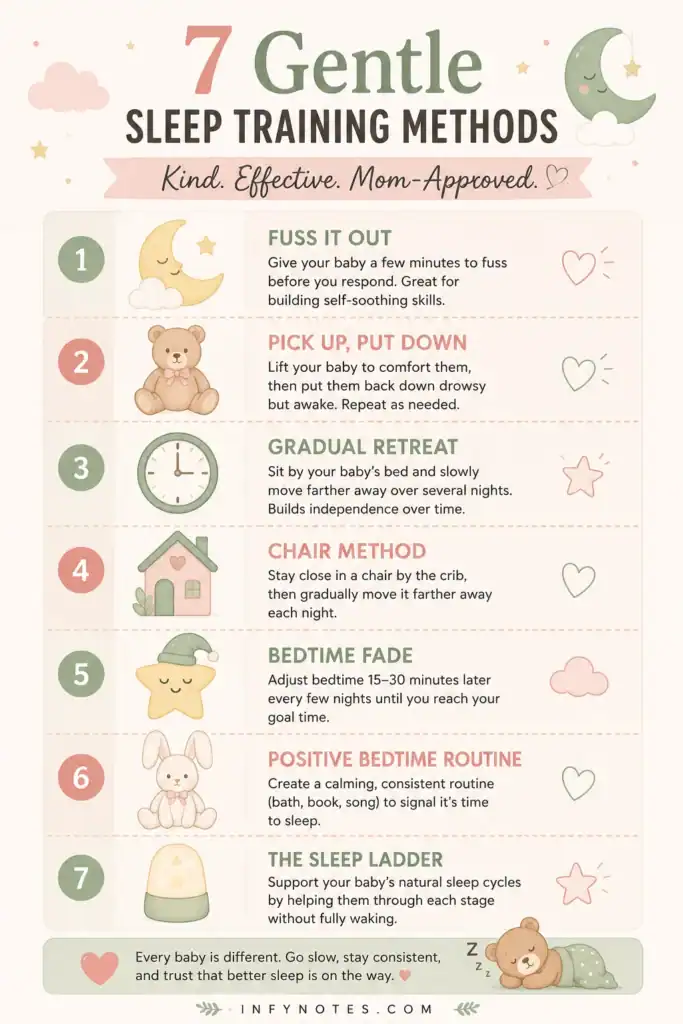
There’s no single “right” gentle sleep training method. The best one is the one you can stick with. Here are the most effective options, from least to most independent:
1. The Fading Method (Chair Fading / Parental Presence)
You gradually reduce your involvement over time. Start by sitting next to the cot, then move your chair further away every few nights until you’re outside the room. It’s one of the most popular gentle sleep training approaches because you’re never fully absent.
Best for: Parents who find leaving the room very distressing
2. Pick Up, Put Down (PUPD)
When your baby cries, you pick them up to calm them, then put them down once they’re settled but still awake. You repeat until they fall asleep. This gentle sleep training method requires patience and can take longer, but it prioritises physical reassurance.
Best for: Younger babies (4–6 months); parents who want hands-on involvement
3. The Sleep Lady Shuffle (Kim West Method)
A structured but compassionate version of chair fading. You sit beside the cot for 3 nights, then move to the middle of the room for 3 nights, then the doorway, and so on. One of the most recommended gentle sleep training programs by certified sleep consultants.
Best for: Parents who want a clear, structured plan
4. Bedtime Routine Fading
No dramatic changes — just build and lock in a consistent bedtime routine (bath, feed, story, song, bed) and stick to it every single night. Over time, the routine itself becomes a powerful sleep cue. This is often the first step of any gentle sleep training approach.
Best for: All ages; perfect as a starting point
5. Dream Feed
A strategic late-night feed (usually 10–11 pm) to “top up” your baby before you go to sleep, reducing the chance of an early-hours wake-up. Not sleep training per se, but a key tool in a gentle sleep training toolkit for breastfeeding and formula-feeding mums alike.
Best for: Babies 3–6 months; tired parents who want longer first sleep stretches
6. Timed Checks (Modified Ferber / Gentle Version)
You put your baby down awake, then check in at increasing time intervals (e.g., 2 min, 5 min, 10 min) — but instead of fully picking up, you reassure with voice and brief touch. This is a gentler adaptation of the Ferber method and still falls within gentle sleep training territory when done responsively.
Best for: Parents who are ready for some independent settling but not full CIO
7. No-Cry Sleep Solution (Elizabeth Pantley Method)
A very gradual approach from author Elizabeth Pantley that involves tracking sleep patterns, slowly removing sleep associations (like nursing to sleep), and replacing them with new ones. The ultimate low-pressure gentle sleep training strategy — but it takes weeks rather than days.
Best for: Parents who want zero tears and have time on their side
Expert Tips to Make Gentle Sleep Training Work Faster
Even the kindest gentle sleep training method needs consistency to succeed. Here’s what sleep specialists and experienced mums recommend:
Start with naps, not nights. Practising gentle sleep training for babies during the day first — when you’re less exhausted and more patient — helps your baby get the hang of self-settling before you tackle nights.
Watch wake windows. An overtired baby is harder to settle. Track how long your baby has been awake and aim to start the wind-down before the overtired meltdown hits. Most 6-month-olds need 2–2.5 hour wake windows.
Keep the room dark and use white noise. A pitch-dark room and consistent white noise remove sensory stimulation and signal sleep — making any sleep training without crying method significantly more effective.
Be consistent for at least 2 weeks. Most parents give up after 3–4 days. Gentle sleep training often takes 10–14 days to show real results. Consistency is the difference between progress and starting over.
Separate feeding from sleeping (gradually). If your baby always falls asleep feeding, try moving the feed earlier in the routine — feed, then story, then bed. This breaks the sleep-feed association gradually. For more on managing feeds alongside a schedule, our 3-Month Baby Feeding Schedule: The Honest Mom’s Guide has some brilliant starting points.
According to La Leche League’s guidance on night feeds and sleep, many breastfed babies naturally night wean when solid foods are introduced — so if you’re nursing, feeding-related night waking often reduces on its own with time and a gentle sleep training approach.
Mistakes to Avoid with Gentle Sleep Training
Even well-meaning parents can accidentally make gentle sleep training harder. Watch out for these common pitfalls:
Starting too early. Babies under 4 months genuinely need night feeds. Trying gentle sleep training too soon leads to frustration for everyone.
Inconsistency between caregivers. If mum does one thing and dad does another, your baby gets mixed signals. Everyone needs to be on the same page with the chosen gentle sleep training method.
Changing the method every few days. Give your chosen approach at least 1–2 weeks before deciding it isn’t working. Switching too quickly resets your progress.
Skipping the bedtime routine. A predictable wind-down is non-negotiable in gentle sleep training. Without it, your baby has no signal that sleep is coming.
Expecting perfection. There will be bad nights. Teething, illness, growth spurts — all of these temporarily disrupt sleep. That’s normal. Go back to basics and don’t panic.
Comparing your baby to others. Some babies respond to gentle sleep training in a week. Others take a month. Your baby isn’t broken, and neither are you.
Sleep Products That Support Gentle Sleep Training
The right environment makes a huge difference. These products are trusted by sleep consultants and recommended by mums who’ve been through gentle sleep training for babies — they won’t do the work for you, but they make the whole process significantly easier.
🔊 White Noise Machine — Consistent background sound masks household noise and mimics the womb environment. One of the single most effective tools for any no cry sleep training approach. Look for one with a timer and adjustable volume.
🌑 Blackout Curtains — A dark room signals sleep regardless of the time of day, which is essential when you’re nap-training too. Proper blackout (not just “room darkening”) makes a noticeable difference.
👶 Baby Sleep Sack / Swaddle — Replacing loose blankets with a sleep sack is safer and creates a consistent sleep cue. Many mums using responsive sleep training swear by the transition from swaddle to sleep sack at around 3–4 months.
📹 Video Baby Monitor — Allows you to watch and listen without entering the room unnecessarily, which is key for timed checks and fading methods. A two-way audio monitor is especially useful.
🌙 Nursery Night Light — A warm-glow, red-spectrum nightlight (not blue or white) helps during night feeds and checks without disrupting melatonin production — yours or your baby’s.
📌 Save this guide for later — pin it to your Baby Sleep board so you have it handy during those difficult bedtime battles!
FAQ: Gentle Sleep Training Questions Moms Actually Ask
Q: Does gentle sleep training really work?
Yes — but it takes longer than more intensive methods. Most families using gentle sleep training see meaningful improvement within 2–4 weeks when they’re consistent.
Q: Is gentle sleep training bad for babies?
No. Research consistently shows that responsive, gradual gentle sleep training does not harm the parent-child bond or cause emotional harm. In fact, better sleep benefits the whole family’s wellbeing.
Q: Can I do gentle sleep training while breastfeeding?
Absolutely. Many gentle sleep training methods are designed to work alongside breastfeeding. You simply adjust feeds to earlier in the routine rather than eliminating them.
Q: What age is best for gentle sleep training?
Most families begin gentle sleep training between 4–8 months, but it can be adapted for toddlers too. The methods look slightly different depending on your child’s age and developmental stage.
Q: How long does gentle sleep training take?
Most gentle sleep training methods show results in 2–6 weeks with consistent application. Some babies respond faster; some need more time. Progress isn’t always linear.
Q: What if my baby gets sick during gentle sleep training?
Pause the process during illness and go back to your comfort-based approach. Once your baby is well for 2–3 days, you can resume gentle sleep training — often with less regression than you’d expect.
Q: Is the “No Cry Sleep Solution” effective?
It’s one of the most popular gentle sleep training books for a reason. It works, especially for parents who want a low-intervention approach — but expect it to take longer than other methods.
Disclaimer: Always consult your paediatrician or GP before starting any sleep training programme, especially if your baby was born prematurely, has a medical condition, or is not gaining weight appropriately. This guide is for informational purposes and does not replace professional medical advice.
You’re a Good Mum — Even on the Hard Nights
If you’re reading this at midnight with a baby on your chest, know this: choosing gentle sleep training means you’re choosing kindness. Kindness for your baby, and kindness for yourself.
Gentle sleep training isn’t about forcing your baby into a box. It’s about patiently, lovingly, consistently creating conditions where sleep can happen more easily — for both of you.
You don’t have to choose between being responsive and getting rest. Gentle sleep training proves you can have both.
Pick one method. Start tonight. Give it two weeks. And remember — every mum who’s been where you are has come out the other side.
You will too. 💛
Did this help? Save it for those 3 a.m. moments — and share it with a tired mum who needs it.